Friday, July 26, 2013

Hey Victor!

(From the movie "Smoke Signals," starring Adam Beach and written by Sherman Alexie, based on one of his short stories. I saw this movie when it came out in 1998 and to this day whenever the name Victor comes up anywhere, I imitate the goofy, braided dude in these clips.)

Sometimes it takes a long time, and a little bit of persistence, to prove you're not crazy. Not right, perhaps, but also not insane.

Roughly 20 years ago I maintained to just about anybody who would listen, that international pop superstar Prince had changed his name to Victor. This was just prior to the Purple One's decision to become known as an unpronounceable symbol. Obviously, my voice was ridiculed, lost in the clamor about how ridiculous (or awesome, depending on how you felt about Mr. Little Red Corvette's music, fashion and attitude) it was that Prince was changing his name to a provocative glyph.

Some people thought Prince made the change just to prove how Prince-y he was, that he didn't care about names and that, dammit, he could do whatever he wanted. I wasn't a Prince fan at the time, but even I had to admit that he seemed somehow sexier now that he'd shed the name that us mere mortals used, in favor of an otherworldly emblem.

Why did Prince change his name? In part because, under terms of his contract with Warner Bros., he owed the label five albums. He wanted the freedom to explore, to not toil under the demand of creating hits. So he figured by using the symbol, he could release music on a smaller label, and fulfill his Warner contract with music from his massive vault.

For more on the contract tussle, read this.

An artist as prolific and talented as Prince (I've come around on him since the early '90s, although I don't own a lick of his music) needs to constantly challenge himself. He has no desire to do the same thing, or be called the same thing, forever.

But nobody believed me when I said I'd heard that Mr. Purple Rain had at one point decided to change his name to Victor. I couldn't cite my source, but I knew I'd heard it somewhere. Over the years, this just became one of those things that made me "me." Oh, Dave's the guy who thinks Prince was going to change his name to Victor. Dave's the guy who saw "Brother From Another Planet." Dave's the guy who's into Phantom Tollbooth.

I had a chance to ask the Man himself about this, years ago, but I chickened out.

I was working at Webnoize, where I was a writer and editor. The details of how I was put in touch with His Purple Highness are lost to me, but I may have been working on a story related to the launch of Prince's paid online music club.

I was told that I could only communicate with Prince via AOL Instant Messenger (AIM), an account I didn't have. One of my coworkers, however, did and was more than happy to let me use it. My coworker's last name was Karp, and his AIM screen name incorporated the name. At one point, Prince (who was supposedly using AIM through an associate as well) asked something along the lines of, "Who is this person who's named after a fish?"

I recall that his answers to my questions varied between silly and generally useless, and somewhat helpful. I printed out a partial transcript (I was unable to capture the entire text) and saved that print-out for quite a while. I wish I had kept it, so I could quote from it.

I don't remember whether I seriously considered asking him about the whole Victor thing, but I'm sure I joked about it, and I seem to recall people giving me a hard time after the fact for not broaching the subject.

With all the talk this week about the The Woman Formerly Known as Kate Middleton (now the Duchess of Cambridge) having given the British monarchy an heir to the throne, I got to thinking about good ol' Prince Rogers Nelson.

So I decided, for the first time in a long time, to seek confirmation for my Victor theory. Past efforts on Google, Yahoo! and AltaVista (I told you I've been at this a long time) were fruitless.

Finally this week Google gave me a few hits.

I found an article written by the pop music critic for the St. Paul Pioneer Press, Jim Walsh, on August 16, 1994:

In writing about Prince's song, "The Sacrifice of Victor," which is about abuse the Purple One suffered as a child, Walsh concludes this way: "Wait a sec. Did I say Prince? Scratch that. And forget all those other ones - Symbolina, TAFKAP, Victor; I think I just figured out what to call the guy.

"His name is Lazarus. And he is funky."

And from PrinceVault.com:

"Since the album (with the unpronounceable symbol) began with 'My Name Is Prince' and ended with Prince stating "...my name will be Victor", many media outlets reported that (the symbol) could be referred to as Victor, some fans even going so far as to show how the symbol could be broken to form the letters V-I-C-T-O-R."

On tour around that time, however, TAFKAP made comments that "my name ain't Prince, and it damn well ain't Victor."

So I was wrong, but I still claim vindication.

Wednesday, July 24, 2013

Going On the DL

I'm having arthroscopic hip surgery tomorrow, and will be on crutches for as many as six weeks. I will also need physical therapy for roughly the same amount of time. So that translates to perhaps three months of being on the disabled list.

Yesterday I went for a four-mile walk, something I will miss in the next few months. I haven't been able to run in a long time, and my surgeon told me that since I'm not an elite 48-year-old runner, I shouldn't return to that activity. So I've been enjoying walking over the last several months, two or three times a week.

I walk along a path that for much of the time is adjacent to the Charles River. I really enjoy hearing the birds, seeing other walkers, runners, cyclists and kids playing along the banks. I've been monitoring the progress of a new apartment development behind the Stop & Shop.

Simple things like walking up and down the stairs, going to the grocery store and hanging out in the neighborhood will be much more difficult for the next several weeks. I won't be able to amble about taking photos as much, either, which is why I went out today and snapped a bunch of pictures in Chelsea, a small, blue collar city just north of Boston. I'll be posting pictures broken out into a few series on my other blog, The Backside of America, in the near future.

My brother and his family, along with my sister, will be visiting here two weeks after my operation. We plan on doing some things in Boston, but I'll have to take it easy, unfortunately. I'm hoping we can do a duck boat tour and a few other things that won't tax me too much.

I'm going to miss the annual golf tournament in my hometown that I attend every year -- another bummer. I'm going to miss going to a Red Sox game with Owen on August 1st.

And I have no idea how much better I'll feel after the surgery, recovery and therapy. At this point, I'm not even sure exactly what the surgeon will do. I know he'll be cleaning out some torn cartilage that's gumming up my hip. I don't believe he's repairing the tear, but it's conceivable that he will.

The doctor told me I won't be back to 100% at any point, so I don't know what that means. Will I be able to do four-mile walks, three times a week, and not feel the discomfort in my groin, hip and lower back that I often feel? Will I be able to play softball and run the bases a bit?

Only time will tell. What I do know, is that I'm gonna have plenty of time on my hands to post updates here, and to read books, and to write a short story that I promised my buddy Jim Corrigan for his next anthology. Stay tuned....

Wednesday, July 17, 2013

Vacation reading?

I don't consult best-seller lists, and rarely read book reviews, whether they be in the Boston Globe or Entertainment Weekly, the only two publications I read regularly that offer such things. And when the hot weather descends and it's time to hit Cape Cod for a week, I don't confer with summer reading suggestions either.

What did I read last week while hanging out on the Cape with Beth, the kids and Beth's family? A light mystery or upbeat biography? A collection of humorous short stories or a memoir about how swimming with dolphins can change your life? Not quite.

I took on Stewart O'Nan's The Circus Fire. An easy, breezy read this ain't.

The book, which came out in 2000, is an achingly complete reconstruction of the events leading up to, during and after the 1944 circus fire in Hartford, CT, that killed 167 people.

I forgot we had the book, and I don't remember who gave it to either Beth or me. I found it in the attic a while ago and put it in my pile of "to read" books. I'd cruised through August Kleinzahler's memoir, Cutty, One Rock, recently, and wanted to take on something a little weightier.

I could've chosen Isabel Wilkerson's The Warmth of Other Suns, but I knew I'd never finish it in a week. That will be my next book, after Bill Bryson's I'm a Stranger Here Myself: Notes on Returning to America After 20 Years Away, which is a collection of essays that are funny, insightful and easy on the brain.

O'Nan (author of, among many other books, Faithful, a chronicle of the Red Sox' historic 2004 season, which he co-wrote with Stephen King) obviously did a lot of research for The Circus Fire, his first major nonfiction work.

At times, I got lost in the minute details he provides about various victims, both before, during and after the fire. But for the most part, I was engrossed by the history of fires in the circus industry, the details of circus life, the individual stories of courage and heartbreak, and the amazing work investigators did to try and identify victims and solve the case.

I was born in Hartford's St. Francis Hospital in 1965, and grew up 10 miles north of the city. I recall hearing about the fire during the course of my life, but I never knew just how awful it was. Here's a video that will give you just a very basic idea of the horror:

This book is obviously not for everyone. It's a tough read a lot of the time. O'Nan gives in-depth descriptions of the horrendous scenes of struggle and escape from inside the tent; the condition of the survivors and the dead; the agonizing attempt by family members to identify the charred and mangled bodies at the makeshift morgue.

But as a history lesson, it's fascinating. O'Nan details how negligence on the circus operators' parts -- ranging from narrow entrances/exits to animal chutes that blocked easy egress -- led to so many people dying. He also spends time analyzing how people react to unexpected, traumatic situations such as fires, and how they may see flames but since it's so out of the ordinary, their brains don't register the situation right away. O'Nan also talks about how in mob scenes too many people act only in their own interest, and how they too often blindly follow what everyone else is doing, instead of considering other options of escape.

Unfortunately not enough people have learned the lessons that the circus fire offered, as evidenced by events such as the Beverly Hills Supper Club fire in Kentucky in 1977, and The Station nightclub fire in Rhode Island in 2003.

Thursday, June 13, 2013

Running on Empty

I ran all the time as a kid -- on the baseball diamond, the football field (which were the same patches of grass at the school next to my house), the street hockey rink (?), at recess. But it wasn't until I was in college that the thought occurred to me of running for no other reason than to stay fit.

Even then, I didn't stick with it. I would run occasionally during the summer, and lift some weights and do push-ups and sit-ups, but I never stuck with it during those years.

I always wanted to be one of those people who ran year-round, no matter what the weather, or how sick or hungover I was. I wanted to have those tight calves and the lung capacity of a horse.

After college, I hiked, went on walks or rode my mountain bike every so often, but I didn't run for many years. After I got married I did a little bit of running, but then in April 1998, seven months after my wedding, I ruptured my Achilles tendon.

Six months after undergoing surgery and rehab, I decided to try running again, but I decided to commit myself to it a little more. The first time I went out, I barely made it half a mile before I had to stop for fear my lungs were going to expel themselves out of the top of my head.

I kept at it, and before too long I was regularly going a few miles, a few times a week. I even had favorite running gear for the colder days: a white sweatshirt that my Uncle George had given me as a Secret Santa gift a few years before. It said "Be alert. The world needs more lerts" on it. I wore it inside-out.

I can't say I ran regularly through the winter, but I definitely stuck with it, on and off, for the longest I'd ever done it. In 2000, Beth and I bought our first house, in Boston's West Roxbury neighborhood, and I continued to run.

In April 2001, I ran my first road race, a 10K in Dedham, Mass., called the James Joyce Ramble. I ran with my buddy Dave, a seasoned runner. Along the course at random points, there were kids doing Irish step dancing, and people dressed in period costumes reading from James Joyce books. It was a great time. After the race, Dave took care of me, fetching me a beer and a donut.

I became enamored of running and doing races. I ran a few 5K's, and then decided to try a half marathon, slated for October 2002.

I ramped up my runs through the late summer and into the fall, and felt good. I knew I should do some sort of cross training or strength training, but I didn't. I finished the half marathon in just under two hours, which I was excited about.

I ran that same race, the BAA Half Marathon, the next two years, and did pretty well. I ran the Ramble and other, shorter races in the next few years.

In 2005, when I turned 40, I decided I'd had enough of the softball I'd been playing for a few years, and give baseball a shot. I'd played Little League and Babe Ruth for seven years, and really missed hardball action.

I played for four years and had a great time, but I managed to injure something each year. The first year it was my groin/abductor muscles. Over those few years I also had hamstring, quad and more groin issues.

I did some physical therapy after the first injury, and strength training on my own at the YMCA off and on during those years. I continued to run on a somewhat regular basis.

I stopped playing baseball in 2009 because it was taking too much time from my family on Sundays in the summer. I got into a more regular running groove, and decided that, after several years off, I would run another half marathon.

I heard about a new race, the Chilly Half Marathon, being run right in my town, Newton, in November. I decided to train for it.

Once again, I had little problem extending my runs. I got up to between 11 and 12 miles a few weeks before the race, then tapered off. I thought about strength training, but didn't do it.

My first Chilly went very well. The weather was cool and I ran a pretty good time, somewhere right around two hours, although I don't remember if it was just under or just over.

In 2011 I decided to run the race again. And once again I blew off any kind of cross training and strength work. The training went pretty well, although I began to feel the miles in my left quad.

I finished the race but was pretty sore and stiff by the end. The pain and discomfort lingered for a few weeks, so I took a break from running. In addition to my quad, I was feeling pain in my groin and weakness just above my left knee.

I found myself wishing that I'd done some strength training.

Over the next several months I alternated between resting or going for walks, and testing things out by going for runs of two or three miles. There were times when I didn't feel much, if any, pain during and after a run, and I was encouraged. Other times, however, I made it only a mile or so before I had to walk, with a bit of a limp.

Finally, last fall I went to my primary care doctor for a physical, which I was overdue for anyway. He said I was in good health, but that my running career was probably over.

I decided I needed a more informed opinion, so I contacted a sports medicine practice. The orthopedist didn't see anything in my x-ray, so he prescribed six weeks of physical therapy.

The therapist theorized that I had a hip condition, although my groin was giving me the most trouble. After six weeks, I realized that not only was my groin not improving, but my hip and back were feeling worse.

Back to the orthopedist, who said I needed to get an MRI. Two weeks after I did so, I returned to his office and he told me I had a tear in my left hip labrum, and that he was sending me to a surgeon.

That guy took a look at the MRI, concurred with the torn labrum, and gave me the low-down on surgery and recovery. Unfortunately, I'll be on crutches up to six weeks after the July 25th surgery. And then I'll need more PT. When I asked the doctor if I'd be able to return to running at some point, he said, "If you were an elite 48-year-old runner, I'd say yes. For the rest of us, however, we need to do something new."

I've been walking two or three times a week for a while now, and while I have some discomfort afterwards, it's manageable. So walking is a post-surgery option. But I don't get enough of a cardiac workout doing that. Swimming seems like a good option, but I know it'll take a long time to build up to a point where I don't hate it.

Biking? I'll have to talk to the doctor and therapist about it.

If you've made it this far, congratulations. Here's a Jackson Browne song that I don't like that much, but which is sorta appropriate:

Thursday, May 30, 2013

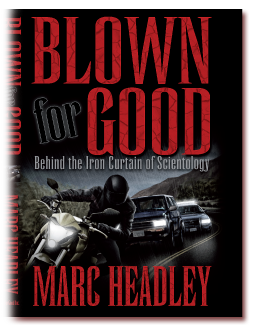
Book Review: "Blown for Good" by Marc Headley

I will tell you right off the bat that Marc Headley's Blown for Good isn't well written. Headley too often gets bogged down in Scientology jargon and abbreviations, uses way too many exclamation points and can be sloppy, repetitive and ham-handed.

But the story he tells is utterly fascinating.

Like many folks, I was aware before reading this book that Scientology was a weird business masquerading as a religion. I knew that big-name actors such as Tom Cruise, John Travolta and Kirstie Alley were Scientologists, alongside lesser-known names such as the musician Beck and the actor (and Beck's brother-in-law) Giovanni Ribisi.

I knew little, however, about how the everyday Scientologist lived. Headley joined Scientology when was 15, because his mother did. He attended their schools and before too long, moved into one of their West Coast facilities and began working there.

At age 16, Headley became the treasury secretary for the group's Association for Better Living and Education International (ABLE Int -- Scientology loves its acronyms), which controls, among other things, four of Scientology's non-profit organizations.

At age 16, he's in charge of finance for a major organization, but like most people living at Scientology's heavily guarded compound in California, he's unable to have a driver's license.

The fact that Headley, and countless others in the book, are put in charge of projects and departments that they're clearly not qualified for, amazes me. I believe that head Scientologist David Miscavige runs the system this way so that he can come in and look like a genius when his underlings screw up, and then bust them down to slave-level jobs so it takes them a really long time to climb the ladder.

In order to move up the food chain, members are required to take course after course based on the teachings of Scientology's founder, L. Ron Hubbard. They are also regularly "audited," during which they are grilled for hours while hooked up to an E-Meter, which is similar to a lie detector. If they exhibit physical reactions that lead the auditor to believe they're lying, or hiding something, then they don't pass, and have to study some more.

Headley recounts being audited a number of times by Cruise, when the "Top Gun" actor was earning his stripes with Scientology. Members who don't live in one the group's compounds pay thousands of dollars for courses and auditing. This is how Scientology makes its money. Well, that and selling books and videos to members.

I was just astounded at how much of a cult Scientology is. Those who are members of what's called Sea Org wear matching uniforms, live in Scientology-owned housing, often work 100-hour weeks for little or no pay and are warned that if they ever try to leave, they will be cut off from their families who are still in the "religion." Short for Sea Organization, the name Sea Org is rooted in Hubbard's late '60s initiative to teach Scientologists aboard three ships, an effort that many attribute to Hubbard's need to evade the prying eyes of the U.S. Food and Drug Administration and Internal Revenue Service.

I could go on and on about the mental and physical torture that Sea Org members, and those living in other Scientology encampments, endure, and about how bizarre their litany of courses and organizations and books and films are, as Headley describes them. But I feel as though in doing so I would drive myself crazy.

That's how I felt while reading this book: that I was going insane. The Scientology culture is so claustrophobic and controlling and filled with meaningless jargon -- and I haven't even gone into their belief that all humans have lived past lives going back trillions of years!

I'm sure there are other, better written accounts about life behind Scientology's barricades. I recently added Janet Reitman's Inside Scientology: The Story of America's Most Secretive Religion to my Amazon wish list.

If, like me, you get consumed by labyrinthine issues and outraged by how the I.R.S. in 1993 granted tax-exempt religion status to Scientology basically because the revenuers were exhausted by a barrage of Scientology lawsuits, then read this book. Or check out Reitman's book and let me know how it is.

Maybe this video of Supreme Scientolgist David Miscavige and Tom Cruise will convince you to buy a book:

OK, I just watched that video and wow, is Tom Cruise an idiot? Is he a robot? I think he's trying to come across as enthusiastic and serious and committed, but I don't see it or hear it. All I can do is shake my head.

Wednesday, May 15, 2013

Out of My Hands...for Now

Last week, after more than a year of on-and-off work, I emailed the manuscript of my road trip memoir to six friends and family members. The book isn't done, but I needed to get it out of my hands and in front of the eyes of impartial readers. This is a big step for me.

I spent 10 years writing my first book, (C)rock Stories: Million Dollar Tales of Music, Mayhem and Immaturity. I received some feedback during that process, but I was never confident enough to send the finished product out ahead of time to see what people thought. While I'm proud of the book, I know it would've been better if other folks had looked at it before publication.

I self published that book, and I may do the same with my memoir. I'd like to find a publisher, but no matter which way I go, I want the memoir to be the best possible book it can be. I've already received some helpful feedback, and at least one person has read the entire manuscript. I'm anxious to read the comments he emailed.

In the meantime, I'm working on two short stories in a planned series about growing up in Simsbury, Connecticut. I plan to submit one of the stories to my buddy Jim Corrigan, who's soliciting stories for his second anthology. He recently self published the first one, Movable Feasts, which includes one of my stories.

I'm also moving forward with my children's book. As I write this, Staples is salivating over the order I placed online today to get five copies of a mock-up of the book. Once those are in hand, I'll schedule a meeting with the folks at Ward Maps, who are the official licensing agent for the MBTA. For those who don't know, my book is about riding the MBTA's Green Line in Boston. If the book gets accepted, I plan to write at least three other books in that series.

The picture at the top of this entry is one I took with my first camera on a family trip in 1977. I was 12 years old, and loved boogie vans. I shot that beauty in Salt Lake City. I plan to include that photo in my book, along with others such as the van I traveled in, shots of myself and some of the guys I traveled with, and pictures of me before the trip, when I was fat and had a beard.

I hadn't thought much about including photos in the memoir, because I had none from the trip. I'd brought a camera and shot two rolls of film, but when I went to get them developed, I was told they were blank. That was the same camera I'd used to take the van photo up there, I believe. I threw the camera away in disgust.

But upon reading Satan Is Real, the autobiography by Charlie Louvin, and seeing the pictures he included, I realized I could insert pictures into my book that, while they weren't from the trip (with the exception of one or two taken by somebody else), would contribute to the overall product.

Stay tuned for more about the memoir, as I'll know more about how much more work I have to do once I get more feedback.

In the meantime, please to enjoy Fu Manchu:

Tuesday, May 7, 2013

Hip

Yes, I know that based on the title of this post, you're expecting a treatise on the latest cool music or beard style or organically raised vegetable I've discovered or cultivated or raised.

But, no, this entry is all about aging and the breakdown of the physical body. Or at least about how a guy with flat feet, a repaired Achilles tendon and a family history of leg and back issues is dealing with turning 48.

Nearly two weeks ago I was diagnosed with a labral tear in my left hip. I'd been experiencing pain in my left adductor/groin area since November 2011, after training for and running a half marathon. Over the next 10 months or so I alternately rested, went for walks or short runs and went to the gym. The pain in my groin, and sometimes in my hip and lower back, persisted.

Finally, last fall I went to my primary care doctor for an annual physical. He didn't have much to say about my groin pain, other than, "I think your running career is over. That's OK, you can swim."

I needed more information and clarity, so I made an appointment at a sports medicine practice. The orthopedist there took X-rays, which didn't show anything. He prescribed 6-8 weeks of physical therapy.

Although I was complaining of adductor discomfort, the therapist figured that my hip was the problem. He began to focus his efforts on that area, as well as my lower back. After going twice a week for six weeks, I wasn't noticing any improvement, so he wrote up his observations and sent me back to the orthopedist.

The ortho told me to get an MRI. That experience was quite a trip, and not in a good way. Oh, it wasn't that bad, but sliding into a giant metallic tube that makes awful, grinding and bumping noises for 25 minutes with nothing to do but contemplate the avant gardiness of it all isn't my idea of fun.

After a week off with Beth and the kids in Vermont, I returned to the ortho to get the MRI results. The good news: "You don't have arthritis in your hip. The bad news: you have a tear in your labrum," which is the soft tissue that holds the ball of your hip joint in its socket.

I was experiencing all of the symptoms: a "catching" sensation in my hip, pain in my groin, stiffness or limited range in the hip joint. I've also been feeling weakness just above my left knee, and sometimes a sense of weakness all the way down to my foot.

And, as of Friday, I've got severe back spasms that make me walk like an old man. I've had pain like this before, but it hasn't been this bad in quite some time. I'm trying not to get too bummed about all of it. I've got an appointment with a hip surgeon at the end of this month, and I'm hopeful that before too long I'll get arthroscopic surgery and be on the road to more normal activities.

I'm not sure I'll return to running, although I'd like to. Perhaps I will have to take up swimming.

None of this comes as a surprise to me. Ever since undergoing surgery in 1998 to repair an Achilles tendon that I ruptured playing basketball, I've known that my left leg was more susceptible to stress and strain than my right. Add to that my two flat feet, weakened abdominal muscles from hernias I had as a kid, and my left leg is under some serious strain.

AND...my father also ripped (but didn't rupture) his Achilles tendon when he was younger (although older than I am now), and has suffered from arthritis and other issues with his back and knees for the last few years at least.

While I'm a bit depressed that I seem to be following in his footsteps at too early an age, I'm confident that surgery and rehab will get me back on track. In the meantime, I need to keep myself in as good a shape as possible, which means doing exercise and strengthening work, and not eating and drinking like a pig.

Now, who wants to talk music, beards and vegetables?