Showing posts with label simsbury. Show all posts

Thursday, March 28, 2013

Holy!

I'm not at all religious, but in recent years I've come to really appreciate churches for their beauty.

As a kid, I went to church school at a few different houses of worship: the First Church of Christ in my hometown, Simsbury, Connecticut, and the Unitarian Church of Hartford, which is hands-down one of the oddest looking churches you'll ever see. Check it out.

My parents eventually made the move from the latter church to the Universalist Church of West Hartford. There, I was in the youth group through 8th grade. I can't say I particularly enjoyed church school or the youth group, or learned any lifelong lessons, although I think I turned out alright. The best part of the youth group was a pretty girl named Johnny, who was really nice, and who, on a car ride back from the group's visit to the Connecticut School of Broadcasting, had to sit on my lap. I think she was supposed to be in the second car, but ended up with me and a bunch of other boys. I was the envy of the other kids on that day, if not on any others.

Anyway.

For quite some time now, I've found myself drawn to churches. The buildings, not the teachings. I love the tall, gleaming spires, the clock towers and the statues. I appreciate both grand edifices and intimate chapels.

I decided recently to expand my photographic horizons beyond cute pictures of my kids and not-so-cute shots of collapsing buildings and abandoned railroad tracks, and begin documenting churches that catch my eye.

Below are the first two photos, with some information about the buildings. Look for more shots here on occasion.

Parish of St. Paul #3

The Parish of St. Paul, Newton Highlands, Mass.

From the Parish of St. Paul web site:

"On the first day of May, 1883, ground was broken for a chapel at the corner of Walnut Street and Lake Avenue. On Thursday, July 19, 1883, an opening service was held in the new chapel. Cost of the chapel was $4,100, including the land, and the new parish began life with a mortgage for $1,500.

"In 1888, the parish purchased the land on which the present church is located for the construction of the first rectory. Within the next decade, additions were made to the chapel and an organ fund started. But the growing parish had outgrown the chapel by the turn of the century.

"In 1902, the rectory was moved to Columbus Street and the chapel was rolled across Walnut Street on logs to where the church stands today. The chancel was enlarged, and the left transept was built to provide a connection to the proposed parish house. The first service in the new church was held on Sunday, October 12, 1902."

First Church in Belmont

First Church in Belmont, Belmont, Mass.

From The First Church in Belmont web site:

"The church building, erected near today’s post office, was dedicated on October 28, 1857. The Town was then founded in 1859, and the church spire can be seen in the Belmont Town Seal. In 1890, a new stone-based church church was nearly complete across the street when the original burned. The bell tower contains the official town clock."

Wednesday, August 24, 2011

My Nascent Archeology Career


I've long been interested in archeology: I'm fascinated by the stories of discovery in Egypt's Valley of the Kings; Jordan's ancient city of Petra; the trove of material uncovered during Boston's Big Dig project; really, any place where scientists locate and delicately reveal pieces of the distant (and not-so-distant) past.

I subscribe to American Archeology magazine.

Here's some quick background on the above photo. When I was 14 or 15, two older kids in my neighborhood told my friends and me that they'd rummaged through an abandoned house close to the nearby railroad tracks. It was full of somebody's stuff -- lots of it, they said.

So my buddy Pat and I (and maybe his brother, Bryan) hoofed it down the tracks, then slid down a hill leading to a swampy area until we got to the house. Sure enough, the place was empty of people, but full of all the things that make up a life: boxes and cans of food; framed photos; clothes; magazines, books and newspapers; a mannequin (?); pots and pans.

I imagine we went back at least one more time, although I can't recall (it's been a looooong time). I don't remember when the house was torn down. In the early '80s, when I was 18, a road was built right near where the house had been, leading over the train tracks and into a new condo development.

While I didn't know the people who had lived in the now-abandoned house, the memory of walking through the detritus of their lives haunted me for quite some time. OK, maybe I wasn't dwelling on it in college, but through my 20's and into middle age (oh man, is that what 46 is?) I've continued to puzzle through the situation. Why did the owners leave behind everything? Were they forced to leave? Who were they? How long had they lived there?

I remember that the people in the pictures in the house were African-American. I let my mind wander to dark places when I thought about these unknown folks. Did racists from my hometown threaten the family, forcing them to flee? I doubted it, but I just had no clues as to what had gone on.

Fast forward to August 2011. I joined a group on Facebook called "I grew up in Simsbury, CT." I posted a question wondering if anybody knew anything about this abandoned house, and lo and behold, two people not only knew of the house, but had visited the old man who lived there back when they were teenagers.

They told me his name was President Little (what a name!) and that he was the son of slaves. One of them said he had no family to leave anything to when he died, which was why the house was left in the condition that my friends and I found it. The other Facebook commenter said, "President was a great man, and all the kids loved him."

Well, I was thrilled to uncover a piece of the puzzle. I had a name, and the fact that the man claimed to be the son of slaves (or that somebody remembered it that way) backed up my memory of seeing a black family in pictures in the house. A quick Google search turned up some basic genealogical facts. Turns out President Little's parents weren't slaves, as they were born in the late 1800's. But it's entirely possible he was the grandson of slaves.

I also discovered that President Little had five kids, and as best as I can tell, four of them were alive in 1981 when he died. It's possible that one or two of them are alive today. So why didn't he leave the house and his belongings to one of them?

As fate would have it, I had a trip to Simsbury planned for last Friday, August 19. I played in the 7th annual Ben Nascimbeni Memorial Golf Classic. I set out from home a bit earlier than I needed to in order to try and find anything at all at the site where President Little and his family had once lived.

I turned off Route 10 onto the road leading past where the house had been, and into the development. I walked back down the road, toward Route 10, looking for an entry point into the thick woods that shield the development from the road.

Finding no path, I just plunged in, camera in hand, not caring at all about the fact that I was wearing neat and clean golfing clothes. The going was a little rough and muddy, but within five minutes I stumbled across what I figured was the remains of President Little's abode.

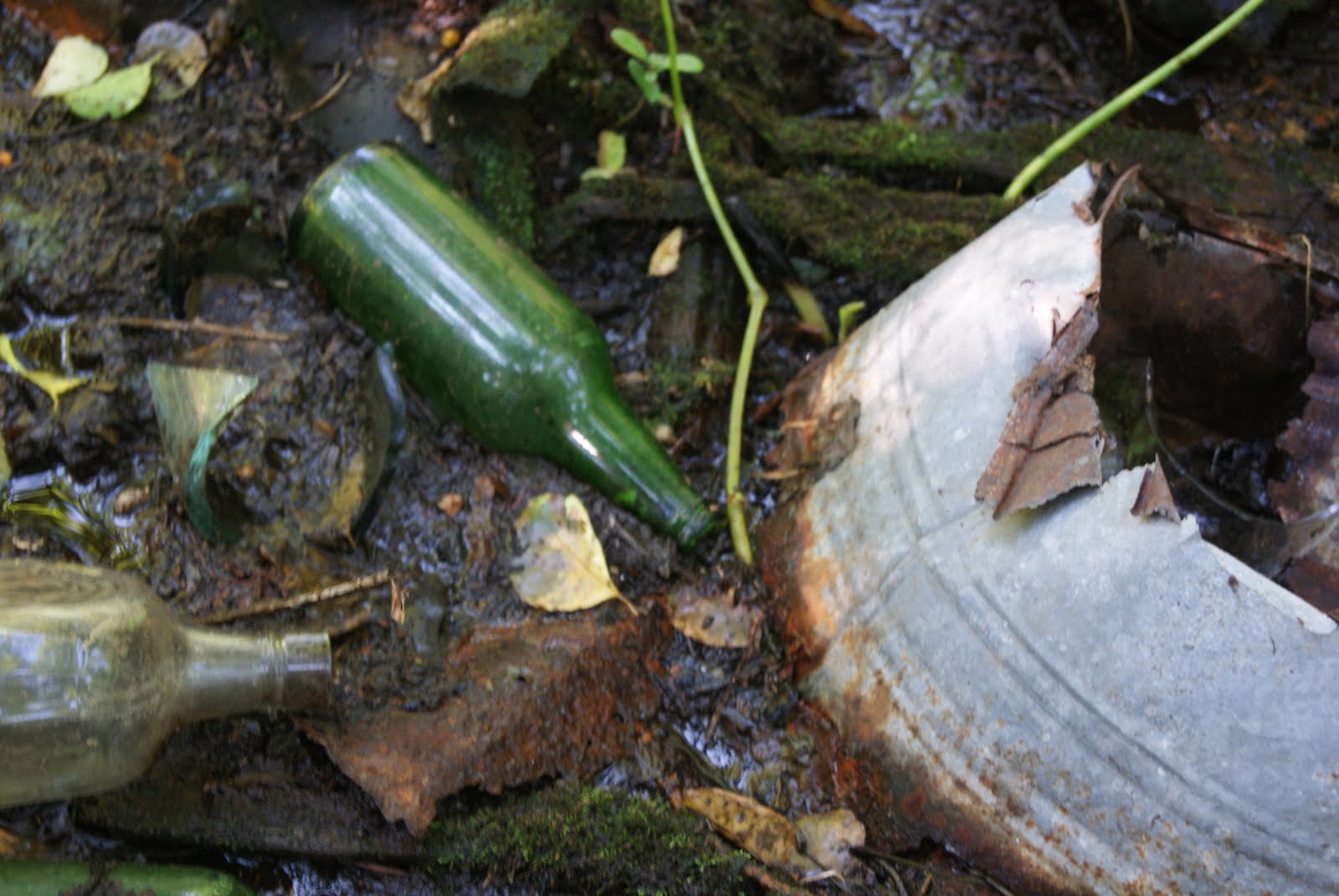
Upon my approach, I could tell I was in the right place. It looked like this:


I stepped carefully through the mud, and around the objects, and things began to come into clearer focus.


I was thrilled that I'd found this location that had been on my mind so often over the years. I was proud of myself for taking the plunge into those woods and so quickly locating the spot. These feelings were mixed with sadness, however, about the fact that somebody's life and belongings were slowly sinking into the muck. I was also shocked, frankly, that whoever had torn down the house had removed big items like furniture and appliances, but simply left behind these smaller items.

So what now? I'm not sure. I've talked in the recent past in the abstract sense of wanting to write a book about this house and its abandonment. Now that I've discovered the name of the man who lived there, and been to the site, strangely I feel less of a need to take on something as big as a book. Honestly, I never knew what form the book would take.

I do plan, however, on finding out as much information as I can about President Little, his family, the house, people who knew him, etc. And put together an article of some sort and try and find a market for it.

This project brings together so many of my interests: history, archeology, genealogy, my hometown, detective work. I can't say why this concept has stuck with me for such a long time. Encountering the abandoned house all those years ago made quite a mark on my psyche, and I've felt the need to solve the puzzle, even though I have just a very tangential connection to the people involved.

Stay tuned....

Wednesday, July 27, 2011

I Love a Parade...and a Carnival

St. Mary of Carmen Festa #8

Each summer growing up, I looked forward to the annual Simsbury Volunteer Fire Company's carnival the way a drunk joneses for his next bottle of booze. The carnival was held the same week in July. The festivities opened on a Wednesday (or maybe Thursday) and went through the weekend, with a parade on Saturday night. I got almost as excited for the parade, with its scores of area fire departments, marching bands, trucks, police cars, clowns throwing candy, etc., as I did for the rides and games of skill at the carnival.

I loved the Ferris wheel, the Rotor, the Spider, the Goolamajig -- OK, I don't remember the names of all the rides, but I loved everything about the whole event.

I would go to the carnival on one or two of the early nights. It was held at Weatogue Park, where I sometimes played softball, or knocked around golf balls or just ran around or rode my bike. I loved the games, from tossing a ping pong ball into a fish bowl (I'm glad I never won; I didn't actually want the fish), to pitching nickels in order to win all sorts of glassware: Miller beer mugs, parfait glasses, ashtrays (it was the '70s), banana split dishes -- you name it, I won it and stashed it in my closet for years and never used any of the stuff for anything other than storing loose change.

On Saturday evening, my family and I would walk down to the corner where our road, Mountain View, met with the parade route, Latimer Lane. We'd hang out with my friends the Keegan boys and bounce around until the parade started. We could see up the hill to where the parade started. There was always a police car at the head of the line, and when we saw it moving down, we'd yell out, "It's starting! It's starting!"

Fire trucks from all around Connecticut and parts of Massachusetts (and perhaps Rhode Island and New York) streamed by, honking horns, blaring sirens, flashing lights. There were bands made up of firemen (there may have been a few women, but it was mostly men back then), a high school band or two, with baton twirlers. Old fashioned fire trucks, ambulances and other public safety vehicles filled things out.

My high school's theater group even rode by in a truck, promoting whatever show they were putting on that summer ("Guys 'n' Dolls," "The Fantasticks," etc.). It was quite the community event.

The parade wound about another mile or so to the carnival grounds. My friends and family, of course, made our way to the park, usually taking the train tracks as a shortcut. The firemen had a special section near the back of the grounds, near the brick tower where they performed rescue and fire drills, where they caroused with their wives and families. I used to think it would be so cool to hang out in that roped-off area.

After more rides and games and food (cotton candy, popcorn) I went home, my carnival and parade needs sated for another year.

The next morning my friends and I walked back down to the park to look for money, discarded prizes and anything else of value. One time, I found a $5 bill, and being the goody-goody that I am, I turned it in to some people breaking down the event, just in case someone came back looking for it.

The fire department canceled the event in 2000, after nearly 50 years, after realizing that the amount of work that went into the event wasn't worth the meager tally of dollars flowing in. For more, see this article.

In 1979, when I was 14, a local church, St. Mary's, started a competing carnival, which still runs in June after 32 years. While that carnival doesn't have an attendant parade, and never seemed quite as glamorous as the firemen's carnival, I'm glad my hometown still has an event like it.

I was reminded of carnivals and parades after recently taking some pictures at the St. Mary of Carmen Society festival in my adopted hometown of Newton, MA. Known as "the festa," the event is put on by an Italian-American group associated with a local Catholic church.

The carnival, which I've attended with Owen in years past (although not this year), runs from Wednesday to Sunday in the middle of July. At 10:00 on the final night, there is a candlelight procession from the parade grounds to the church. Parishioners and residents of The Lake, as the section of town is affectionately known, follow behind a statue of Mary, singing songs in Italian and holding candles. Along the route, people launched numerous fireworks, which add to the festive atmosphere, but, in my opinion, take away some of the solemnity.

St. Mary of Carmen Festa #6

I walked right in the procession, alongside many older Italian-American men and women, and although I had no idea what they were singing, or had any sense of the tradition, I was moved. I have no ethnic customs in my family, so whenever I get a chance to soak up somebody's else's, I enjoy it.

The procession ends at the church, where a local girl dressed as an angel is hoisted up above the faithful, and tosses flowers.

St. Mary of Carmen Festa #2

Afterwards, most people filed into the church. I, of course, didn't.

I vowed to return next year, however, to get better pictures, and to witness the Sunday afternoon procession, during which parishioners attach dollar bills to the statue of Mary.

Friday, July 8, 2011

Heredity

Big Alex

("Big Alex," Felton Street in Waltham, MA)


I was reminded during a recent visit with my sister how much I loved big rigs when I was young. She's five years older than I am, and told me that to this day she remembers the difference between a cabover and a conventional truck tractor because of how obsessed I was with spotting 18-wheelers.

Previously, I hadn't thought about how similar my one-time appreciation for big trucks is to my 9-year-old son Owen's current love of subway trains. I used to ride my bike down to the heavily traveled Route 10 in my hometown, Simsbury, CT, so I could spot trucks. I would hang out for quite a while, trying to get them to blast their air horns. And when they did, I got a real thrill.

I was totally into CB radio lingo, even buying a book so I could learn some in case I picked some up on my walkie talkie while I was watching trucks. Did I watch "BJ and the Bear" on TV? Yes, I did. Did I love C.W. McCall's "Convoy" when it played on the radio? Yes, I did.

I've never seen "Convoy" the movie, however, which I need to rectify.

In the last two years or so, Owen and I have gone on close to two dozen trips on the Boston subway system. He loves the trains, the stations, the noises, the connections between places. I love to take pictures and see parts of Boston I don't usually see from the highway or local streets.

Just as I now take my son on subway trips, my dad helped feed my truck obsession, although not to anywhere near the degree that I help Owen. My dad took me to a truck dealership in Hartford once, and explained to a driver outside how much I loved trucks. Faster than you could say, "10-4, good buddy," I was climbing up to take a look in the cab.

Another time, on a family vacation out west, we stopped for the night at a motel in Salt Lake City. I was in the outdoor pool and saw a truck pull into the parking lot. Once again, my dad asked, and once again, I got to check out the cab.

Also, I loved the "Smokey and the Bandit" movies when I was a kid.

And I had a favorite 18-wheeler when I was a kid. In the center of Simsbury was a factory called Ensign Bickford. They had a red-white-and-blue cabover Peterbilt parked there with a double sleeper. I used to dream of breaking through the security fence and driving that thing away.

Why did I love trucks so much? Because they were big, and loud and the best ones had huge chrome smoke stacks, running lights that lit up the night and the guys driving them looked like cowboys. I imagined that driving a semi truck was all fun: traveling the open road, being your own boss, sleeping in the truck like it was a camper, meeting people from all walks of life.

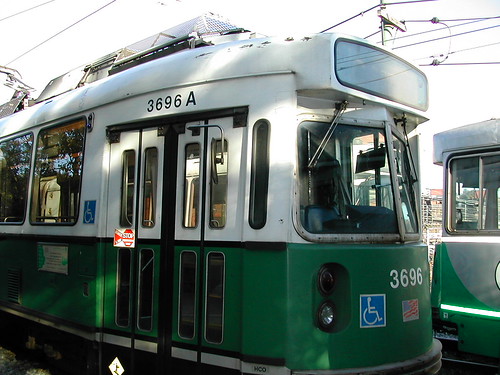
Now, like me, Owen dreams of one day driving a big rig, although a subway car is a much different beast than an 18-wheeler. He loves the Green Line more than any other, and keeps track of which trains we've ridden (they have four-digit numbers prominently displayed), which ones have derailed in the past, which ones have been repainted. His favorite stations are Government Center and Park Street, because the trains squeak the most as they come around the bend at those stations.

And, like my sister, I've learned a lot from exposure to a young boy's deep interest. Thanks to Owen, I know the difference between a Kinki train and a Breda train, for instance.

I wonder what Owen's kids will be obsessed with. Maybe spaceships.