Showing posts with label fiction. Show all posts

Saturday, June 5, 2021

"Blitzed"

At the beginning of this year, my buddy Steve Z. told me about a Ramones anthology that Fahrenheit Press was putting together. He had submitted something, and encouraged me to do the same. So I did. In late May, I found out that my story had been rejected. Trying to make me and the other poseurs feel better, Fahrenheit said they might put out a second Ramones volume, thereby doubling our chances to be rejected!

I've been a Ramones fan since my late teens; I saw them four or five times during my college years. My college band, The Toastmen, played "Blitzkreig Bop" at many of our shows. I own just a few Ramones albums, but really, isn't that all you need?

Fahrenheit wasn't looking for stories about the Ramones or even featuring the punk godfathers from Queens. What the publishing house asked was for writers to use a Ramones song as an outline or the theme of a story. There needed to be a connection to the song. "Keep it punk and keep it stripped down: 2k to 4k words only," the publishers said. "Preference is for clean narratives. This is punk storytelling. Don't over intellectualize it."

Below is "Blitzed," the story I submitted. It references "Blitzkrieg Bop" and features Scarlett, my favorite character from my short-story anthology, (C)rock Stories: Million-Dollar Tales of Music, Mayhem and Immaturity.

Blitzed

By Dave Brigham

“Yankee-boy, we’re coming to get you,” Scarlett whispered as she slowly rolled the El Camino down the litter-strewn alley behind Sniper’s Lounge. Her brother, Ray, rode shotgun, nervously caressing a pair of their daddy’s handcuffs.

“I can’t believe he’s headlining Sniper’s,” Ray said, pushing his platinum-blonde tips out of his eyes with manicured, black-lacquered fingernails.

“Of course he is, dipshit,” Scarlett spat at her brother. “He’s the fucking best there is in this town! He’s gonna clear 200, 250 bucks tonight. And then he’s gonna go for a little ride.”

Parking behind the graffiti-scarred dumpster, Scarlett pulled her cigarette holder from her purse.

“Eh hem.”

“Oh, Jesus, Scar. Why did you bring that goddamn thing?”

“A lady always needs to be delicate,” she said in her baby-girl voice, fluttering her eyelashes. “Now put a fucking Misty in my ox-horn cigarette holder!”

Scarlett flashed her headlights. A van parked 50 feet down the alley flashed back, then drove toward the club’s back door.

Through the swirling smoke from Scarlett’s extra-long cigarette, she and Ray watched as the heavy, black door swung open. In an instant, their two hired goons bolted from the van, grabbed the tall, thin guy who walked out and shoved him in the van. After a minute, the driver stomped on the gas and floored it toward the El Camino.

“What just happened?” Ray asked his sister. She slapped him.

“Those monsters you hired just abducted the bus boy.” The van pulled up to Scarlett’s side of the car.

“You stupid morons…” Scarlett yelled. Just then, Ray grabbed his sister by the shoulder – something he immediately regretted – and turned her toward the Sniper’s rear exit.

“Look!”

“Yankee-boy,” Scarlett whispered. “Alright, Raymond Justice the Third, it’s time for us to right the wrong committed by your large and idiotic friends from bridge club, or wherever it is you found them.”

“What about this guy?” one of the lugs in the van asked.

“Drive him around the block and drop him in front of the DQ,” Scarlett snarled.

Turning to her brother, Scarlett tingled with excitement and rage. “Don’t you, my younger and completely inferior brother, ever touch me. Ever.”

“Relax,” he replied, sweat rolling down his back.

Leaning closer, she whispered, “Ever,” in his ear, then grabbed the handcuffs off his lap.

“Let’s go.”

###################

Scarlett and Ray’s band, Fey Raye, a glam-punk quartet that rolled makeup train cases into their gigs before amps or guitars or keyboards, had been grinding for five years. Some local critics – “sad mama’s boys with too many glasses and not enough balls,” Scarlett said – used words like “annoying,” “shrill,” “god-awful,” “pretentious” and “hairspray-infected” to describe Fey Raye.

They had plenty of fans, though, among the record-store crowd, theater nerds and those looking for something a little dangerous. They played out a few times a month. Their one album, two EP’s and five singles sold well enough to keep the band members from having to get more than three part-time jobs apiece.

Yankee-boy and his band, Northern Army, became the darlings of the scene from the moment they moved to town. With his preppie good looks, tight wiffle and D.C. street cred, Yankee-boy drew crowds at every gig, anxious just to be near him, to scream along to his lyrics calling for revolution and to thrash to his bandmates’ tight hooks and pounding rhythms.

Scarlett didn’t like him, but deep down admitted to herself that he had an important magnetism. She was confrontational with him, just as she was with everybody else.

“Alex,” she laughed the first time she was introduced to him. “That’s about the most boring name any of God’s creatures ever did give an offspring. You talk like a fancy boy who went to Yale and learned about chromosomes and how to set proper margins on a typewriter and quadratic equations and laying down a bunt and using salad forks and how to find Ursa Major and Ursa Minor.”

She took a drag from her Misty.

“You probably skateboarded with people calling themselves punks, who were, in reality, rich kids who’d been kicked out of Georgetown row houses.”

Alex laughed.

“I do believe I’m going to call you Yankee-boy,” Scarlett said.

Alex was always nice to her, finding any small nugget of promise to encourage her band.

“Maybe we can cut a single together,” he said one night after Fey Raye opened for Northern Army. “Cool, right? You’ll be on the B-side, of course.”

“That ain’t gonna happen,” Scarlett replied, the air thick with exasperation. “Y’all are too pretty, too nice, too stuck-up, too tweedy. Our band is the real shit. We scrape our insides out and show them to our fans and they love us for that. You boys talk about revolution, but you already had yours. You ‘northern’ boys. We’re gonna blow up, soon. You’ll see.”

###################

As Ray chatted with Alex about Fugazi’s Repeater album, Scarlett snuck up behind the tall, muscular singer. Grabbing his left wrist, she slapped on a handcuff. He wheeled quickly, knocking her to the ground.

“What the hell?!” he yelled.

“Grab him, Raymond!” Scarlett demanded.

Ray jumped at Alex, but bounced off his right fist. Scarlett jumped on Alex’s back and began pummeling his head. In an instant, Alex flipped Scarlett over his head and on top of a charging Ray. The siblings sat there, stunned.

“What the hell?!” Alex yelled again. “What are you idiots doing?”

“Oh, Yankee-boy,” Scarlett purred. “We just wanted to take you to a party. Do you wanna go to a party, hun? Our band is playing and we were hoping you might deign to accompany us and maybe sit in for a song or two.”

“Well, why didn’t you just ask? You know I love to sing!”

“Do you need to help your band break things down?” Ray asked.

“Do you need to help your band break things down?” Scarlett said in a mocking, sing-songy voice. “Of course he doesn’t, you lily-livered sack of pancakes.”

“Scarlett’s right,” Alex said, laughing. “I carry those guys every night; they can spend a little effort to pack up my mic.”

Ray’s hired goons showed up and joined Alex in the back of the El Camino. Ray passed a bottle back through the sliding window.

“Want some Bop?” Ray asked Alex.

“What the hell is ‘Bop’?”

“Blitzkrieg Bop!” Scarlett screamed. “It’s Jagermeister, Goldschlager and Rumple Minze. It fucks you up.”

Alex took a long slug, passed it along. The goons drank deeply, too. Pretty soon all five of them were screaming and laughing at the top of their lungs as they headed deeper into the woods toward Scarlett and Ray’s father’s house.

“Whatta we want!?” Scarlett yelled from the driver’s seat.

“Punk rock!” the rest of them answered at full volume.

“When do we want it?!”

“NOW!!!”

“Gabba gabba hey!” Ray yelled. “We accept you one of us!”

“Lame!” Scarlett retorted.

Alex started rolling around in the El Camino’s bed, bouncing off the two goons. “Mosh it up, assholes!” he yelled. Then, standing up, he started pogoing and then slamming himself to the hard metal of the truck’s bed. “I love the Bop!”

“Yeah, Yankee-boy!” Scarlett yelled through the window. “He’s losing his mind – I love it!”

The road turned to dirt, the trees stooped menacingly close to the roof of the El Camino. The moon beamed onto Alex’s white t-shirt; everything else was black: Scarlett’s hair and dress, Ray’s leather jacket, the goons’ jeans and boots.

Ray jammed a cassette into the player. “This’ll heat shit up,” he said.

“Keep your hands on the wheel / But you’re playing with my stick / “I can’t help it if I slip / Keep your hands on the wheel”

“Is that Ram Jam?!” Alex yelled at Ray as he bent down to the window. “Turn that shit up!”

“Hell yeah, Yankee-boy!” Scarlett howled. “Get crazy!”

Scarlett drove past a few dozen cars and pulled into the driveway. There was a bonfire in the front yard, with people scattered around eating, drinking and dancing. On the expansive front porch, some dudes were plugging in amps, checking mic levels, setting up a drum kit, taping down cords, fixing a small spotlight. Paint peeled all around them.

Alex and the goons hopped out of the back of Scarlett’s car. A buzz pinballed through the crowd as more partygoers recognized the tall lead singer of Northern Army. Scarlett and Ray walked up on the porch; they talked with an older guy for a minute or two, then plugged in.

The older guy approached the mic, held onto it loosely with a right arm covered in tattoos.

“Hello, shitheads!” he yelled out. About six feet tall, with a pot belly barely hidden under a Link Wray t-shirt, the master of ceremonies was clearly Scarlett and Ray’s father. He had the same head of untamed black hair and crooked grin as his kids.

“Happy to have you here,” he said. “Don’t wreck my house or shit on my lawn. And if I see you mistreat my dogs – you know who I’m talking about, you two meatheads – I’m shooting first and asking questions later.” People clapped and whistled.

“OK, here’s Fey Raye.” And he jumped off the steps in a lame attempt at a stage dive.

“Jam out the kicks, motherfuckers!” Scarlett yelled and the band flew into a manic rage, the porch sagging under the heavy boots stomping away to the beat. Scarlett played guitar and sang; Ray was on keyboards and backing vocals; a skinny, longhaired guy in a Husker Du t-shirt attacked the bass; and an athletically built guy with a GBH shirt and a pink Mohawk pounded the drums.

The small crowd pulsated in the front yard, mesmerized by the music, stoned out of their minds, drunk on Blitzkrieg Bop. Alex stood on the fringe, pushing people back into the makeshift mosh pit, yelling encouragement, pogoing in place.

After three songs, Scarlett stepped back from the mic, shook sweat off her hands and took a long swig of something. The liquid sparkled in the stage lights.

“Let’s hear it for the Bop!” she yelled.

“Don’t hurt yourselves out there,” Ray said as he adjusted his mic.

“Fuck that,” Scarlett snarled. “They are revved up and ready to go!” The crowd whooped and screamed. “Alright, you idiots. This next song is a cover, and we’re gonna drag someone up here to sing it” A few hands shot up in the air, as if they were at karaoke bar rather than an illegal backwoods club run by a possibly psychotic punk and her gun-toting father.

“Yankee-boy, where are ya?”

“Nah, nah, Scarlett, this is your gig,” Alex called out through cupped hands. He took a few steps back, careful to avoid the dog shit. Lifting his plastic cup in the air, he saluted his rival: “To Scarlett – true punk, madwoman behind the wheel, mixologist extraordinaire!”

The crowd roared.

“Yankee-boy, don’t be rude. Don’t refuse a lady’s entreaty.”

People were getting restless. A few people yelled at Scarlett to play another song. Ray told her to forget it. Others, the drunker ones, started chanting, “Alex! Alex! Alex!”

“Where are Ray’s bridge-playing friends?” Scarlett said, all sugary sweet. “Get your fat asses moving, and get that boy up here!” she commanded.

The two lugs appeared out of nowhere, hands on Alex’s back, shoving him toward the stage. He fought them for a few seconds, but then, like a true professional, put on a big smile, jogged up the steps and wrapped Scarlett in a bear hug.

She stepped back, yelled something in his face then, after windmilling her right arm, launched into “Jet Boy” by the New York Dolls. Ray scrambled from behind his keyboards to grab his guitar and catch up with his sister.

Alex bumbled his way through, remembering most of the lyrics and singing some of them in time with the band as Scarlett kept charging faster and faster until the whole thing fell apart.

The crowd went wild.

“What’re we doing next?” Alex said into the mic, a big smile on his face. “Get me some more Bop, dammit!” Someone hustled up the steps and handed him a sloshing cupful.

Scarlett sashayed up to the mic, a big smirk on her face, blood dripping from her string-slashed fingers. “Yankee-boy, I bled for you,” she said, draping her arm around his neck. “Are you having fun?” she whispered into his ear. He nodded enthusiastically.

A girl at the bottom of the porch steps took off her top and threw it at Alex. Not to be outdone, her boyfriend took off his cut-offs and whipped them at Scarlett, just missing her head. Then they clasped hands and ran off toward the woods.

“They’re gonna go make some steam,” Scarlett cracked into the mic. “Yankee-boy, let’s play another song.” She leaned toward the drummer, spoke quickly to him and the bassist. Ray leaned in just a second too late; Scarlett flipped him off.

Again, Scarlett windmilled and then hit the first chord of The Stooges’ “Raw Power.” Alex jumped up and down, thrilled beyond belief to play this one.

“Dance to the beat / of the living dead / Lose sleep baby / and stay away from bed / Raw power / is sure to come runnin’ to you”

After the song was done, Alex did a flip off the porch and ran a few laps around the front yard, out of his mind. Most of the crowd followed hm around, pawing at him, yelling encouragement, flailing themselves onto the ground as he passed.

“Jesus Christ,” Scarlett mumbled to herself. “How distressingly messianic.”

Clearing the four steps back up to the porch in one leap, Alex was manic. “Let’s do a fuckin’ Ramones song!” he screamed.

“Take it easy, Yankee-boy,” Scarlett purred. “I call the shots up on this stage.”

“Do you guys wanna hear a Ramones song?!” Alex bellowed into the microphone. The crowd – really only about 25 people at this point, but a hardcore 25 – started chanting, “A-lex Ra-mone! A-lex Ra-mone! A-lex Ra-mone!” while they moshed around the front yard in a circle. He jumped back down and got on the backs of a few bikers and rode around the pit, like a king.

“Shit,” Scarlett said to the rest of the band. “Yankee-boy’s got those folks more riled up than a two-dicked rooster in big-city henhouse.”

“Yup,” Ray said, a big smile on his face. “He’s the fucking best there is in this town, as someone once said.”

Scarlett slowly took her guitar off over hear head, then quickly rifled it at her brother. “This ends now,” she growled.

“Hey ho, hey ho, Yankee-boy has got to go!” she chanted through the mic. “Hey ho, hey ho, Yankee-boy has got to go!” She clapped her hands over her head, turned to get her bandmates to join in. They half-heartedly did so.

“Yankee-boy – come on up here!” Alex came bolting to the bottom of the steps. “Stop right there! That’s close enough,” Scarlett yelled, pointing at him menacingly.

“Yankee-boy is the king!” she yelled. The crowd ate it up. “And I am the kingmaker,” she continued. “Y’all love him so much because he’s crazy and wild like I am. He’s only acting that way on account of the Blitzkrieg Bop we been making him chug. Y’all know that, right?” People started to boo and throw things – barbecue ribs, plastic cups, an El Camino hubcap – at Scarlett.

“Come on, y’all, you know I’m right. I make and break this boy. He was nothing before him and his band of marauding union soldiers invaded our scene and saw how Fey Raye dominated it. He needed someone to compete with, and I gave him that. He’s only so damn good because I made him fight for the title!”

“Fuck you!” some guy yelled. “Play a goddamn song!”

“Alright, alright, you weenies. We’re gonna play a song. This is a new one. I think y’all are gonna like it quite a bit, yessirree. “It’s called, ‘Yankee-boy, You’re Fired!”

Scarlett strutted down the steps and over to the El Camino, eyeing Alex the entire time. From the driver’s side door pocket, she pulled out her cigarette holder, inserted it between her teeth. Then, slowly, she unwrapped a new pack of Mistys, gave it a few good hard taps on her left palm, removed one and put it in the holder.

Next, she reached under the driver’s seat, smiling and winking all the while. She pulled out her custom black-and-pink 20 gauge, and began waving it in the air, slinking closer to Alex.

“Hey, Yankee-boy, where you gonna run to?” Scarlett teased as the big man backed up. “You’re not afraid of lil’ old me and my shotgun, are ya?”

“Of course not, Scarlett,” Alex said, suddenly sobered up. “You don’t want me to sing with your band? Fine, that’s cool.”

“No, sir, I don’t,” Scarlett replied, cool as a cucumber. “I’m gonna shoot you in the back, ‘cause you’re gonna start runnin’ like a big old baby-man!” She cocked the weapon.

Indeed, Alex turned tail, along with a half-dozen other people. Scarlett raised the gun to her shoulder, took aim and fired. BOOM!

Alex and his fellow yellow-bellies covered their ears, ducked and screamed simultaneously. Ray and his fellow bandmates howled with laughter. Scarlett let out a rebel yell to curl your toenails.

Crawling out of the mud and piss and beer and Bop, Alex checked himself, saw that he was all there, that nobody around him was bleeding and that he’d been made a fool by a jealous, conniving, delusional harpy.

“Rebel Woman!” Alex yelled at Scarlett. “You are a goddamn crazy bitch!”

“Aw, Alex, don’t be like that,” she purred. “Now be a gentleman, and come over here and light my cigarette.”

Monday, October 9, 2017

Autumn Suite

Today I'm sharing a short fiction suite I wrote 20 years ago for a publication I put out sporadically for a handful of years. SLANK featured short stories, essays, editorials, cartoons, poetry and other art by yours truly as well as friends and family. It was the successor to another 'zine I'd done called frog spit, and a precursor, I suppose, to this blog and my other one, The Backside of America.

So, without further ado, I give you....

AUTUMN SUITE

1) Let Me Leave

I slept outside last night. I fluffed up the dirt, pulled back the blanket of crispy, crackly leaves and wandered off to sleep, dreaming of supernovas, rocks from Mars and creatures from "The X-Files." During the night, smoke from my neighbor's wood stove curled across my yard, into my nostrils, filled my head with warmth and sanity. A dog sniffed his way across the tree line before venturing over to pee at the foot of my resting place. I thanked him.

Bugs wound their way around the stems, up the veins and chewed their way across my leafy blanket. I did not move but to bat an eyelash at them. They didn't care; I was one of them, part of them. I welcomed them.

Around 2 a.m., I woke to a tickling on my chin. Perhaps, I thought, my whiskers are growing more quickly in the fresh, autumn air. But no, it was an inchworm, late for work and hoping to gather some speed by tumbling down my cheek. I laughed at him.

Precisely at 4 a.m., as I'd suspected, the awe-wielding maniac skulked across the yard, scaring the squirrels and crickets into silence. He was surprised to see a pair of beady eyes checking him out from inside this cozy outdoor bunk. He attempted to menace me from twenty paces, but I simply told him to bug off. I waved at him.

At 6, the cock crowed, and this scared the hell out of me, for I have no rooster. I sat upright, and what did I see, but a bright red rooster with a yellow comb on top of his clucky head. He winked at me.

Rising slowly, I took the time to see what the place looked like in the daylight, as I hadn't really done so in a long, long time. I'd forgotten where I lived, you see, what wonders existed in my own backyard, what creatures lived outside my imagination. Things were not so pretty in the daylight as they were under the stars.

There was Johnson's tree house, falling apart and pretending to be the Honeycomb Hideout; Washington's swimming pool, glowing aqua and shimmering with steam; Bailey's broken-down jalopy with windows for doors; Sing's crumbling woodshed mocking Mother Nature; and my own foolish lawnmower, strong enough to propel itself into the next county, if only it were smart enough.

Damn!

Why did reality have to rise with the sun? Why did man have to create so much junk? Why did the axe-wielding maniac leave a trail of blood across my limestone patio?

2) Pumpkinstein

I fear the Great Pumpkin, for he is a mammoth, orange Disciple of Gaia. Born in the musty soil of Concord, hard by Route 2; raised on the vine -- the twisting, gnarly umbilical cord through which Mother Nature's nutrients flow; now, fat with maturity, rolled with great effort and farmer's sweat into the market, to be sold to an unsuspecting victim.

"Three-hundred-seventy-one pounds of pure evil is sitting over there," I tell this kid. "Almost four hundred pounds of grotesquely round menace, colored by the Flames of Hell," I say to him. He runs, screaming his fool head off, back to his mommy and the promise of a caramel apple. I say a quiet prayer for him.

Surrounded by hundreds of squashes of all sizes, shapes, colors, smells and temperaments, only I know where the truly diabolical one sits. Sure, here and there I spy a Hubbard squash or bottle gourd that may send a chill up my spine. But I am not really worried by this. They are merely supporting characters in the Game of Evil being played by the G.P., who sits over there, like Jabba the Hut, next to the rusty tractor, waiting to be thumped just the wrong way, so he can wreak havoc on the world.

My sworn duty -- my reason for being placed ever-so-softly on this Earth -- is to save mankind from the G.P.

Boldly I stride across the open field of the market, brushing aside women and children, making a plumb line for the tractor.

"How much?" I ask the crusty salesman in his John Deere hat.

"Ain't for sale," he tells me in his bad, nasally grammar. "Just for show," he adds, wiping caramel from his hands onto his Big Smiths.

This is not acceptable," I say to him.

"Ain't for sale," he repeats, drone-like.

"Fair enough," I say, smiling.

I stroll nice and easy to my truck. The door creaks as I open it; I slide behind the wheel, thinking about oiling that door, but putting it second on my list, just behind "rescuing mankind." I cruise slowly, past the yuppie parents and their Radio Flyer children with rosy cheeks and tainted minds, to the end of the dirt lot closest to the tractor. Jamming the shifter into "P," I leave the motor running and hustle over behind the tractor. Then I dash for the G.P., using the Lord's adrenaline to help me lift it onto my back and rush over to the truck, where I carefully roll it into the bed, and throw up the gate. As I pull out, I look upon a sea of astonished faces. No one can believe what they've seen. They do not know they've been saved.

Fools.

AS I haul out of the parking lot, an unwitting Tool of Satan veers her stupid Geo in front of me. I swerve to miss her (only out of instinct, not compassion) and the damn G.P. goes flying over the tailgate, bounces off the stupid little car's roof and smashes into pieces on the asphalt.

My foe has multiplied. I cannot hope to thwart him now. Each splinter of pulpy fruit is a harbinger of evil to come. I drive on into the uncertain gloom of the Harvest Moon.

3) Family Portrait

I can smell their shoes.

Walking overhead, their floor = my ceiling. Old boards creek like arthritic joints -- the same ones again and again. It's a shame no one has fallen through. Lately.

Each time they drive away, I scurry up to see what they've left behind. A half-empty Snapple bottle (mmmm....Kiwi-Strawberry) once; a pamphlet about the Worcester Outlets another time; a small footprint preserved in horse manure; the scent of Grey Flannel.

Every year they come when the shadows lengthen, the temperature drops and the trees shed. They stay for an hour or so, until Mr. has made plans to change his life, simplify his goals and move out to the country. I have followed the growth of their children, the rift in the marriage, the patterns of life.

When Boy was a young crawler, he almost fell through a weak board and into my waiting grasp. His little Weebok foot (smelling of new Lexus leather seats) dangled there for a few precious seconds before Mrs. scooped him back to safety. Tantalizing.

Girl = getting to the difficult age, probably 12 or 13 now. She doesn't like to listen to her parents, only to the headphones clamped permanently to her ears. She scuffs her Penny Loafers up (to cover the smell of freshly mown grass) and wears ripped jeans and tight t-shirts. Rebellious, despite the shoes.

I remember Mr. when he was a little older than Boy = now, would come here with Old Mr. -- just the two of them -- and throw rocks into my river and drop pipe tobacco onto their floor = my ceiling.

And I remember when Mr. first brought Mrs. here. She didn't feel right about it, she said. Something eerie about the place. She had ESP, or something, she said. She is still the last to arrive, and always the first to leave. She sniffs the air, looks through the cracks in their floor = my ceiling.

She has never caught on to me. She never will. If Mrs. fell through a weak board, I would throw her in the river. But I would keep her Espadrilles, because they smell of salt water and beachfront property.

This time she seems more guarded than usual, keeping her distance from the family. Girl doesn't notice, nor does Mr., but Boy keeps asking her to hurry along and see the fishes swimming in the river, the bright orange leaves floating along the top. But she is preoccupied.

Finally they all leave, with Mrs. stepping off the bridge last -- something that's never happened. After they drive off, I scramble up top to see what they've left. At first I don't see anything. There are no candy wrappers, baseball cards or cigar butts. Nothing. That's not right.

As I shuffle along close to the wall, I come across a scrap of paper stuck in a crack. It simply says, "OPEN." So I do.

"Dear Troll:" it begins.

"Thank you for keeping watch over my family when we come to visit. I've always known you were there, and have always felt safe, if a little weird. After all these years, I think you should know that I am leaving my husband. I hope to bring the children with me to Florida, so we shall never be here again. My husband will no doubt wish to forget this place after we leave him, so I doubt he will return. Goodbye."

On the back of the paper she had drawn a crude map, which included the bridge, the nearby grove of maple trees and a cluster of large stones that used to be part of a gate leading into an old farm. With an arrow she indicated that under this pile of stones I would find a pleasant surprise.

After nightfall I limped out of my quarters and made my way over to the old wall. Making sure no one had seen me, I lit my kerosene lantern and unstacked the stones.

At the bottom, nestled in the cool, moist dirt was a Saks Fifth Avenue bag. Nervous with anticipation, I opened the bag, ran my hand along the heavy cardboard box inside and closed my eyes, ecstatic. Inside, hidden beneath fragrant tissue paper, was a pair of my very own leather boots, "for the coming winter," her note said.

I always liked her.

THE END

Wednesday, August 12, 2015

Si Amadon Opens the Valise

The valise was where Mr. Farquhar said it would be, under the red maple tree just past the ".5 miles to summit" sign. Normally, Si Amadon would have put Pierre to the task. But this was a delicate mission. "Discreet, all the way," Amadon told Mr. Farquhar.

Getting his oft-shined boots dusty in the pursuit of contraband was hardly Si Amadon's forte. Dapper as Clark Gable, Si Amadon was a teetotaler and physical fitness enthusiast, the living embodiment of his banking business: tightly controlled, disdainful of G-men and zip-lipped.

On occasion, though, he sought out adventure, as it reminded him of tramping through the woods on his family farm as a boy. Though he'd chosen finance as a way out of the hinterland, he still kept in his heart memories of his favorite book, "The Pirate's Treasure or the Strange Adventures of Jack Adams on the Spanish Main."

And so he walked up the mount, his freshly pressed, Hart Schaffner double-breasted overcoat pulled close to maximize a quick ascent. Before he reached the red maple, he caught a whiff of his quarry. His heart fluttered like a money-counting machine and he allowed himself to skip, just once, before reaching behind the tree and taking hold of Mr. Farquhar's gripsack.

Within the folded red silk of the case, under the Kipling book and bottle of powdered rhubarb, beneath the false bottom, Si Amadon found the prize.

Lifting the box, he looked 'round for interlopers. Seeing none, he opened the lid, bent forward just a bit and let the waft rise to his ample nostrils. It was deep and earthy, but also heavenly and capable of transporting him to an exotic, foreign land. He fumbled in his coat pocket for his lighter. Removing it, he admired its dazzling sheen and likeness of a bathing beauty. He fired it and smiled.

Holding the box steady with his left hand, he carefully removed the cigar with his right. It was a Sancho Panza Molinos, trucked up two days ago after arriving in the port of New London. She was a beauty, hand-rolled in Cuba and stashed in a bag of sugarcane. He lit the cigar and savored it. As instructed by Mr. Farquhar, he emptied the box into his coat pockets and placed it back in the valise with the other items.

Then he turned to descend, back to the bank, back to his wife and children, back to a place where nobody knew his vice. There, standing in the middle of the path stood Bigfoot, who snapped this picture.

Thursday, March 19, 2015

The Masquerade

Millard went to the grange that first warm Saturday of spring with murder on his mind. Calvin, a fellow ranch hand, had kissed Millard’s girl, and he was going to hell. Disguise was the key. Tingling in ecstasy as he rummaged his mother’s steamer, Millard imagined the blood splattering on her striped cotton pajama pants. Her swim cap, which lent her elegance that his father’s meager salary denied them all, would make a nice kufi. Beetle-shaped silver earrings – where did these come from? No matter. A bracelet on his wrist, and two over his taut biceps; perfect. From the wooden peg he’d tapped ever so gently into the wall above his sister’s sweet-smelling dresser, he stole the golden mask that had won her flitting favor with the mayor’s son. The silk sash he plundered from the textile museum two towns over, and which his girl had refused, felt lush against his torso. The vest ripped from his father’s closet smelled of failure. From the shed, he took a length of chain, making sure not to get any gold paint on the odd pieces of metal hanging from the links. The piece de resistance: a whimsical horsehair mustache.

Skimming the edges of town, Millard boiled with anticipation. His enemy’s manner with the ladies was as smooth as his ruddy cheeks. The last dance he performed would find him not with a pretty paramour, however, but alone, whirling and twirling as the blood spilled from the cross-shaped wound above his adulterous heart. From the grove of pine trees behind the grange, Millard could see the building was filled with revelers, so happy in the innocence of the moment. Quiet as a ghost, he snuck up to the back door. The smooth pattern and earthy smell of the clapboards warmed his demon soul. In a flash, he was in the kitchen, closer to the ruckus and revelry, his fist tight around a stainless steel knife. The band was raucous, loud enough to cover Calvin’s screams. Millard’s outlandish outfit would sow confusion. The dim lighting offered an easy getaway.

Like a diva taking the temperature of the room, Millard peeked through the window on the swinging kitchen door. In a near corner he spied the young schoolteacher, Miss Hartley, laughing through her nose at the minister’s dim wit. Behind them, under the Stars & Stripes stood his boss, Mister Peavey. “He’d never know me in this get-up,” Millard snickered. A conga line passed close to the door, arms flailing and legs sprawling to the crazy Caribbean beat. He recognized no one. A female pirate. A cowboy. A devil. A witch. A harlequin. “What the deuce? What is going on here?” The calendar pages flipped backward in his mind. He saw himself writing “Masq Ball” on Saturday, March 30. He intended to ask Dolores until he saw that scoundrel plant a kiss on her outstretched hand. Then he marked the last Saturday of March as “Murder Day” on his mental calendar. But where was the Cad? Which of the ladies in disguise was his favorite flower? He could hardly go ripping masks off the celebrants. Join them, he told himself. This will be fun. Murder can always wait.

Thursday, June 5, 2014

Mmmm...Leftovers

I'm excited for HBO's new series, "The Leftovers":

When I first heard of Tom Perrotta's book, which the series is based on, I thought it odd that the author of spot-on high-school popularity contest spoof "Election" and suburban parenting-and-affairs story "Little Children" was taking on Christianity's Rapture fantasy.

Those who believe in the Rapture are certain that Jesus Christ will return to Earth, and deliver Christian believers to Heaven. Those left behind, as it were, will face the end of times, the story goes.

The concept has gotten a huge marketing boost in recent years with the "Left Behind" book series. Nicolas Cage stars in the movie created from that series, which hits theaters in October:

My wife read Perrotta's book last year and highly recommended it, although she didn't tell me much about the story. I finally got around to it last month, and was expecting it to have more of a relationship to Christianity than it does. The book has about as much to do with the Rapture as Justin Bieber does with maturity.

Just as "The Sopranos" was less about the Mafia than it was about screwed-up mobsters, "The Leftovers" isn't really about the disappearance of millions of people around the world, but rather about how the remaining 98% of humanity deal with this shocking event.

I'll be done with this excellent book by the end of this week. Then I'll start reading as much press as I can and watching trailers to get myself psyched up for the HBO series.

Perrotta is co-writing the 10 episodes with Damon Lindelof of "Lost" fame. The series stars Justin Theroux, Liv Tyler and a bunch of people I don't know.

I loved the movie adaptation of "Election"; I never read the book. I liked the movie of "Little Children," but enjoyed the book more. "The Leftovers" is so rich and detailed and has so many wonderful characters, I've got high hopes for HBO's treatment. I hope I'm not let down.

Thursday, February 6, 2014

The Devil Didn't Make Me Do It

Earlier this week I made a list of writing projects that I want to complete in the next few years. Top of the list is my first children's picture book, which is moving along well with an illustrator and the backing of the MBTA, the folks who run Boston's subway system (see January 29, 2014, "Kidding Around").

At the bottom of the list I wrote this:

WHITE DEVIL JOHN SCREENPLAY

MAYBE….

I've never written a screenplay. I have, however, written a few plays. Last March I read an article in the Boston Globe about a Boston gangster known as White Devil John, and immediately I thought, "Talk about a movie-ready name!"

Here's the part of the Globe story I threw into a Word document with an eye toward developing a story based on this case:

They called him Bac Guai John or “White Devil John,” and he was their enforcer.

John Willis was a white man from Dorchester, yet, according to court records, he quietly emerged as a leader among Chinatown’s Asian gangs, historically known for insulating themselves from outsiders.

He had been introduced to the neighborhood’s underworld when he was about 12 years old, learned to speak Cantonese and was essentially adopted by a Chinese family, according to federal prosecutors. From there, they say, he followed the leaders of the violent and once-powerful Ping On Gang, launching a career that spanned more than two decades.

[In federal court he pleaded guilty] to an indictment that painted him as the nexus among low-level Asian gangs that ran rackets in Chinatown, including drug dealing, gambling and prostitution.

After reacquainting myself with this story today, I searched online to see if there were any updates on White Devil John. Turns out, I can erase this idea from my project list.

A book is already in the works, and has been sold to a publisher. Rights for TV, film and a graphic novel have also been sold.

So who's behind the project?

Boston sports reporter turned news anchor Bob Halloran, that's who.

Halloran is a very likable guy who, it turns out, is much more than a good news reader and clever wordsmith when reporting on Boston's teams. He's written at least five books, covering topics ranging from Whitey Bulger and Steve "The Rifleman" Flemmi, to "Irish" Mickey Ward (Halloran served as a consultant on "The Fighter") and the Red Sox.

Working with White Devil John himself -- John Willis -- Halloran has written a non-fiction, true crime tale tailor-made for the big screen (James Gray has been hired to write and direct; Gray's credits include "The Immigrants," "We Own the Night" and "The Lost City of Z," which is in pre-production and is based on a great book I read a few years ago).

Here's part of the blurb from Publisher's Marketplace:

"Still a teenager, John took a job as a bouncer at a club near Fenway Park. After coming to the aid of a young Chinese man named Woping (John Jo in English), John had a friend he would forever call his brother. He was taken in by John Jo's family. He learned to speak Cantonese, grew fond of the Chinese culture of honor, family and Buddhism, and went to work for the Chinese Mob in Boston's Chinatown."

The book will be published by BenBella Books in the spring of 2015.

Friday, October 4, 2013

Bottle On the Brain

The story I wrote for the short story anthology Movable Feasts is called "The Bottle." Set in the late 19th century, the story is about the pettifoggers who peddled curative tonics, and their struggle in the face of a public who was becoming wise to their ways. I just realized that my story would have been much better if I'd used "pettifoggers" in it, because it's one of the best words I've ever found via Dictionary.com.

Published earlier this year, the collection was edited by my good friend Jim Corrigan. Not a man to let grass grow under his feet, Jim solicited stories for another anthology soon after. Whereas the theme for Movable Feasts was "eating out," the unifying concept for the next book is "travel."

I certainly took some liberties with the the theme the first time around, and wrote too many words, but I felt pretty good about "The Bottle." I published my own collection of short stories, (C)rock Stories: Million-Dollar Tales of Music, Mayhem and Immaturity in 2010. All 15 stories were centered on music (and one of them was called "Message In a Beer Bottle" -- go figure), so I wanted to do something different for Jim's premier collection.

When Jim asked if I was on board for his upcoming travel-themed collection, I of course said yes. I had no idea at the time what I would write, but I knew I'd come up with something. I'd been outlining a collection of stories about the town where I grew up, and realized that one of the ideas I had could be molded to fit the travel theme.

One of the characters from my childhood was someone one of my friends dubbed Lady Death. I sketched out a basic idea for the story, and knew that once again my interpretation of travel might be a little loose, but I liked the idea of the story and started working on it.

I've plugged away on and off over the last few months, and have mostly completed a first draft. As I got toward the story's climax, I did a little research that led me to some important information that fit perfectly into my story. I don't want to give away too much, but I will say that, quite unexpectedly, I've ended up writing another story in which a bottle plays a role.

Unlike in "The Bottle," the glass vessel in my new story (working title "Lady Death Trip") isn't a central component. But it certainly plays an important role.

Once I finish the story and things move along toward publication (Jim is working with several authors, and is in the reading phase right now with some of them) I'll offer more details, and let you know when and where you can buy the book.

Tuesday, January 15, 2013

Rock and Writing

This is Tales From the House Band, Volume 2. It is an anthology featuring 15 short stories at least tangentially related to music. One of the stories from my collection, (C)rock Stories: Million-Dollar Tales of Music, Mayhem and Immaturity, is included in this new book. I hope you'll consider buying it and telling your friends and neighbors about it and suggesting that, "Hey, you know, you really don't have enough Dave Brigham in your library."

The book came out without much fanfare back in early December. For some reason, the publisher, Plus One Press, doesn't feature the book on its web site. Nevertheless, it's available online and at brick-and-mortar stores if you ask nicely for them to order it.

I self-published (C)rock Stories more than two years ago, but felt OK contributing one of those stories to Tales From the House Band #2. I'm not sure if Plus One is planning a third installment in the series. If so, I would consider joining in again, if they'll have me (my story, "Three Times a Lady Sniff," is by far the most vulgar story in the book, although, in my mind, also the closest to reality).

If I'm asked, I would write a new story.

I've got a lot on my plate right now, with my memoir, a planned children's book series and my long-on-the-back-burner novel. But I'm excited to write a new story about music, even though I don't have any ideas for one right now.

By the way, I've got a reading planned next month in Portsmouth, NH, at River Run Bookstore. Thanks to my buddy Peter for setting that up. Unlike the reading from Tales that I did in Arlington, Mass., last month, this time I'll be on my own. Which means I'll probably torment attendees with my full story about the trials and tribulations of following the Butthole Surfers on the road.

Hope you can make it.

Friday, November 2, 2012

(C)rock Redux

Today I received a small advance from Plus One Press, which will be publishing one of my short stories in the soon-to-be-available Tales From the House Band, Volume 2. The anthology features stories from numerous genres, with wildly varying themes, but all of them focused on music in one way or another.

I forget how I found out about Plus One's first volume of the series. But as soon as I did, I zipped an email to the publisher asking if there was room for me in the next volume. She said yes, so I sent her one of the stories from my first book, (C)rock Stories: Million-Dollar Tales of Music, Mayhem and Immaturity, for her consideration. She agreed to publish it, which naturally made me very happy.

I didn't have to write a new story, which was a plus. There was some back-and-forth editing between the publisher, a third party and me. But in the end I think my story -- "Three Times a Lady Sniff," about following the Butthole Surfers -- is better.

Subsequently, I did a little research into the first volume. Plus One is a small publisher that issues books by the owner, Deborah Grabien, and other authors. The only reviews I could find online of the first volume were written either by authors who had stories in the anthology, or their relatives.

Still, the possibility of getting one of my stories published alongside those of other writers is a great opportunity. As with a compilation album (do they make those any more?), a short story anthology gives artists the chance to get themselves in front of people who might never have come across their work otherwise. So obviously I'm hoping those who buy the second volume might at some point buy my book as well.

Stay tuned for news about the publication date.

Thursday, August 16, 2012

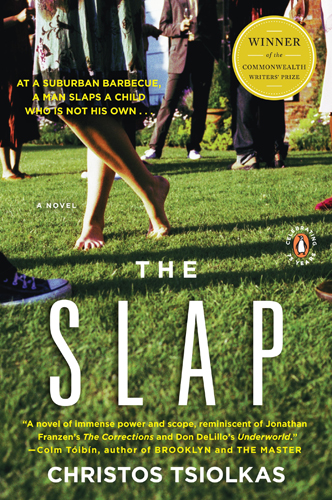
Review: The Slap

The Slap is another paperback I picked up for free at Newtonville Books after buying a full-price hardcover (see July 24, 2012, "Review: That Old Ace In the Hole").

I'd never heard of the book or its author, Christos Tsiolkas, but I liked the premise: a man slaps somebody else's child at a backyard barbecue, and as a result, a group of friends, acquaintances and family members question their parenting abilities, their cultural differences, their ideals and their relationships to each other.

Plus, it's an Australian tale and who doesn't love the Aussies?

As with the last book I read, Annie Proulx's "That Old Ace In the Hole," I feel that this book could've used a heavier edit. What's wrong with a novel that's under, say, 400 pages?

As someone who self-published a book ((C)rock Stories: Million-Dollar Tales of Music, Mayhem and Immaturity) that needed better editorial oversight, I know of what I speak. I had spent so much time getting the book ready for publication (10 years, give or take) that I couldn't stomach the idea of someone telling me where to make changes, or questioning the ideas in my book.

But if you're working with an actual editor and publisher, your book should be tighter than Tsiolkas's book. Still, I enjoyed his story and his method for presenting the multitude of difficult and intricately woven issues.

There are eight chapters, each one told from the perspective of a different character. I was impressed at Tsiolkas's ability to see life from so many different angles, both male and female, young (18) and old (69), and make each one seem true to life.

I thought he did an especially good job with the internal monologues of each of the characters. As someone who does a lot of self-talking (what probably appears to the outside world as crazy talk), I can relate to the world of inner thoughts, and how different that realm is to the persona we put forward.

And the view into the various cultures of Australia -- many of the characters are Greek immigrants and their children and grandchildren -- was fascinating. How do the Greeks deal with each other, and the aboriginal natives, and those of English descent? And what are the conflicts among friends who are Christian, Muslim, Hindu or atheist? Good stuff all around.

I know this isn't the most thorough review, but I started this a while back and just want to finish it up, so in conclusion I'll just say that I recommend the book.

G'day!

Tuesday, July 24, 2012

Review: That Old Ace in the Hole

Newtonville Books is a great local store. When they were actually located in my adopted 'hood of Newtonville -- before their move to the tonier Newton Centre -- they for a time offered buyers of hardcover books a great deal: a coupon for a FREE used paperback.

I picked up a bunch of freebies through that offer, a few of which I've read. This week I finished Annie Proulx's That Old Ace in the Hole.

Proulx is well-known and highly regarded. She won the Pulitzer Prize for The Shipping News, which I thoroughly enjoyed, and garnered recognition for her 1997 short story, "Brokeback Mountain," which Ang Lee turned into an award-winning film in 2005.

So after pawing through lots of books by authors I'd never heard of, I was excited to find Proulx's 2002 novel about a young man sent by his new employer to the Texas Panhandle to scout locations for hog farms.

I have to say, though, that the book left me somewhat unfulfilled, as though I'd ordered the Lumberjack Special at my local diner, and instead of Canadian bacon on the side they gave me veggie bacon strips (side note: why hasn't anybody copyrighted Facon and turned it into a viable commercial product?).

Proulx fills the book with incredible descriptions of the Texas landscape:

And it was crazy country too, some of the flattest terrain on earth, tractor-chewed and rectangled, rugged breaks and plunging canyons, sinister clouds too big to see in one look, rusty rivers, bone white roads and red grass -- the oddly named bluestem."

And she populates the book with loads of colorful characters with even more colorful names, such as Freda Beautyrooms, Rope Butt and Ribeye Cluke. As a guy who discovered a love for writing in second or third grade by making up stories featuring the most ridiculous names I could think of, I chuckled at each of Proulx's way-out character names. But eventually I found them a distracting device.

The protagonist, Bob Dollar, has an appropriately generic name, as he really doesn't displace much water in the story, but seems only to serve as a sounding board for other people's opinions and ideas.

He never cares about his job at Global Pork Rind, understandably. But he feels a sense of loyalty, which he attributes to his not wanting to abandon his responsibility the way his parents left him behind as a child, with an uncle, when they took off for Alaska. The corollary just doesn't work.

I was sorely disappointed that this book just didn't seem to ever really come together. I felt as though Proulx kept stringing things along -- plots, character development, scene descriptions -- because she didn't really know how she wanted to end it.

And when the ending did come, it was with a whimper, not a bang, which I guess is appropriate given how dull a character Bob Dollar is.

Now, I'm not gonna lie to you and tell you that I didn't enjoy this book at all. I wouldn't have plowed through its 359 pages otherwise. But I wanted the book to be great, not just OK. I wanted there to be a big surprise or shock here and there, but there really wasn't.

I guess that's why I found this book in the used section, and got it for free.