Showing posts with label road trip. Show all posts

Thursday, July 15, 2021

A 5th Grader Talks About the King of Rock 'n' Roll

Elvis Presley, for those who don't know, is a popular rock and roll singer. He lives in Memphis, Tennessee, in a big house with his parents. He has been in many movies and when he sings, people get excited. He sings songs like "Hound Dog," "Don't Be Cruel," "Jailhouse Rock" and, my momma's favorite, "Picious Minds." He's called the King of Rock 'n' Roll. Also, Old Chairman of the Board, or something.

He's on the $1 dollar bill, so I think maybe he was president when he was in the 1950's. I found a song on the Innernet that says Elvis is Everywhere.

That's pretty good of a song. My dad wrote a song about Elvis that's kind of mean. It's called "Worms Ate His Brain" and it's about how Elvis was supposably dead and how my dad made fun of him. My dad, geez.

Today Elvis is 135 years old. Or wait, no. He was born in 1935. So he's 68, I think. Anyway, he's old but he wears a white suit and boots and has recorded albums with bands including the Attractions, the Jordanaires, the TCB Band and even played baseball with the Texas Rangers.

Some guy named Dave Brigham wrote a book that's about the Elvis Presley Boulevard Inn. And getting drunk in a bar near there. And he went to Graceland, which is where Mr. Presley lives. If you're weird and want to read that book, you can see it in the Innernet.

Monday, July 5, 2021

The Grand Dragon Will See You Now

I have a simple question for you:

When was the last time you were in a Mexican restaurant/bar in Athens, Georgia, shooting pool and chewing the fat with your friends, surrounded by a mix of college students and hipsters and working-class folks and feeling, as a Yankee, maybe just a little bit out of place, talking about kudzu and the red dirt that seemed to be everywhere, and wondering where you might park your van for the night in a strange city, and when the hell are we all going to the 40 Watt Club, and speculating about where to go next on your aimless road trip across America, when out of the blue the bartender -- a nice guy named Vern -- mentioned matter-of-factly that there was a Ku Klux Klan rally just a few miles outside of town?

Part of me wishes that, when that opportunity arose for me in March 1988, I had driven out to see those robed degenerates spouting their hateful bullshit. Sure, I would've been scared to get close, but also fascinated. Read about that incident in my new memoir, Great/Dismal: My Four-Month Tour of Duty on the Battleship Patchouli.

Monday, June 28, 2021

We All Struggle with Something

We name things to help us understand them, and to create a shared knowledge with our fellow human beings. I sometimes get fascinated by language, and trying to figure out how even the simplest of words -- dog, cat, dodecahedron -- came to be. Naming things, however, can put people on a slippery slope. Nobody wants to be defined too narrowly by elements of their character or physical presentation.

Look at me and you might think, "White nerd with glasses." You would be right about that, but there's so much more going on. I play guitar, I love the Red Sox and Bruins, I make terrible "dad jokes," I love Public Enemy and Funkadelic, I love to wander around in strange places taking photos, I have arthritic big toes and a bad hip.

One label I don't mind tagging myself with, though, is person with Attention Deficit Disorder.

More than three years ago, I diagnosed myself with ADD (see November 28, 2018, "ADD Me to the List"). Read the linked post to get the full story on it. I want to reiterate one point, though: realizing there was a name for the collective struggles I had battled my whole life gave me some freedom. I no longer worried that I was crazy or stupid or lazy. Finding the right "tag" for myself was one of the best things that ever happened to me.

In my new memoir, Great/Dismal: My Four-Month Tour of Duty on the Battleship Patchouli, amid the highway hijinks and visits to Graceland, New Orleans and Memphis, the exploration of Albuquerque, the punk rock shows, the flashbacks to college, there is self-analysis. I didn't have as much fun during my adventure as I thought I would, and for years I had no idea why.

During the course of writing the book, I began to put together a better picture of why I struggled, with the light finally shining when I realized I had both ADD and executive function issues. Those two things combined make it difficult for me to plan ahead and stay on task, take things as they come and be more spontanous.

We all struggle with something: hearing loss, flat feet, bipolar disorder, taking care of a sick relative, narcissism, a love of REO Speedwagon. I hope my book will show readers that it's never too late to figure yourself out, and that discovering the name for what you struggle against can be incredibly empowering.

Below is "Cross Bones Style," the only song I know by Cat Power, aka Chan Marshall. She has struggled with mental health issues, so I feel it's appropriate to share her song here.

Saturday, June 26, 2021

That's a Big 10-4!

"Convoy," the 1975 novelty country music song that inspired the 1978 Sam Peckinpah movie of the same name, spoke to me as the Lord speaks to Jimmy Swaggart. I was 10 years old and in 5th grade when the song hit the Connecticut radio waves. Kids brought their copies of the 45 into school and begged our teacher, Mr. Cashman, to let them play it on the classroom record player. Sometimes he said yes; we all sang along.

The song sparked my interest in CB radio. I loved the crazy lingo -- "pregnant roller skate" for a VW bug; "bear in the air" means a police helicopter; "brown paper bag" indicates an unmarked police car -- and even bought a book about it so I could learn and use it. Sometimes when using my walkie-talkie with friends, I picked up trucker conversations and was thrilled beyond belief.

During this same era, I watched "Movin' On," a TV show about truckers, starring Claude Akins and Frank Converse. I was also completely and totally in love with the "Smokey and the Bandit" movies during this time. When I was 14, I watched "BJ and the Bear," a TV show about the trials and tribulations of a trucker and his pet chimpanzee.

At the Big E when I was in junior high school, I bought a metal belt buckle with a semi-truck on it.

You get the idea. I was into big rigs.

I never would have guessed, when I was 12 years old, straddling my yellow three-speed bike by the side of the main road that ran through my town and giving truckers the "blow your horn" signal, that 10 years later I'd be a free spirit, too, bombing down America's highways in a van with three buddies.

Read all about my trip in my new memoir, Great/Dismal: My Four-Month Tour of Duty on the Battleship Patchouli.

Friday, June 25, 2021

Get in the Van

Part of me wishes I didn't ever have to get out of the van. -- Dave Brigham, 2021.

I got in the van, just like Henry Rollins. I got in the van and I liked it -- stomping on the gas pedal and making that V8 growl, sitting in the passenger seat and watching America fly by, reading a book in the back seat and thrilling as the miles away from home piled up, listening to Nancy Sinatra and the Fifth Dimension and Willie Nelson on 8-track.

I got in the van and wished I was as cool as the dudes I read about in custom-car magazines when I was an awkward teen who never thought he'd take a road trip....

I got in the van, and I would do it again in a heart beat.

Read about my road trip in my new memoir, Great/Dismal: My Four-Month Tour of Duty on the Battleship Patchouli.

Thursday, June 24, 2021

Please Buy My Book! (Does This Headline Make Me Look Desperate?)

For nigh on a thousand years, I have been working on and talking about my just-released road-trip memoir, Great/Dismal: My Four-Month Tour of Duty on the Battleship Patchouli (see May 5, 2016, "Here's An Excerpt from My Road-Trip Memoir").

I hit the road with three friends in February 1988, traveling in a converted handyman's van. From Connecticut we traveled down the eastern seaboard, and then on through Alabama, Louisiana, Mississippi, Tennessee, before entering the southwest. We ended up in New Mexico, where we lived for a few months. In 2008, I wrote about this journey on a predecessor blog; in 2011, I began expanding my story into a book. That book has now been published.

Why did it take me 10 years to finish the book? That's par for the course for me. My first book, (C)rock Stories: Million-Dollar Tales of Music, Mayhem and Immaturity, also spent a decade in development. I'm not the most disciplined writer, that's for sure. But, as I discovered part-way through the process of writing my new memoir, I have ADD (see November 28, 2018, "ADD Me to the List"). That means I struggle to stay on task and organize my thoughts on paper, and I can get easily frustrated when I find things to be difficult.

Great/Dismal underwent a lot of changes from the initial draft all those years ago, to the one I hope you'll consider buying today. Because of my ADD (and executive function issues), I also procrastinate like a true professional. So it's not like I spent 10 straight years working on this book. I would leave it alone for weeks, sometimes even months. And even when I worked on it, sometimes progress was painfully slow. Also, I took my hands off it for a while, sending it to friends and family, seeking their input (see May 15, 2013, "Out of My Hands...for Now").

"What's the book about?" you might ask. It's equal parts Jack Kerouac's On the Road, detailing the adventures my three friends and I had while running amok in America (and also the boring parts), and Madonna's Confessions on a Dance Floor, with its nod to classic-era disco as well as new millennium club music.

Wait, that last part's not quite right.

It's a mash-up of Kerouac's famous book; John Steinbeck's Travels with Charley; the Rough Guide series of travelogues; the very tamest of Charles Bukowski; and a mid-life journey to self-discovery. I write not only about the four-month odyssey I took with my friends, but also about the various inspirations for the trip (National Lampoon magazine, the aforementioned Kerouac, a few free-form trips I took at the end of my college years, etc.). Additionally, I flash back to college and spend a chapter analyzing why I struggled to let my hair down during my adventure.

It's the most intimate thing I've ever written, which is another reason that I took so long to publish it. I don't like to talk about myself and my struggles, so this is a big step for me. I hope that if you buy it (and actually read it) you will connect with some part of it, whether the stupid stuff my friends and I did on our journey, or the struggles I had during the trip. And please let me know what you think, whether by posting a comment here, sending me a text or email or a Facebook message, or writing a review on Amazon, where the book is also available (along with other online retailers. You can also order one via your favorite indie bookseller).

Thanks!

Thursday, May 5, 2016

Here's An Excerpt from My Road-Trip Memoir

Over the course of four months in 1988, I took a road trip with three friends in which we covered nearly 6,000 miles across 26 states. I have spent five years writing a memoir about that journey, which we took in a 1977 Dodge Tradesman van. We never parked the van "down by the river," but we did avail ourselves of a few campgrounds, a bank parking lot and a quiet residential street in Athens, Georgia.

The book has changed quite a bit since the first draft. I had previously outlined the basics of the story on my old blog (DaveBrigham.com, which is still active although I haven't posted anything there in years), but was unsure how to launch into my story or how to frame the tale for a book.

Initially I thought I would treat it as "how-to" guide for college students and recent grads, imploring them to postpone joining the working world and explaining to them the good, bad and ugly of taking a road trip. I quickly abandoned that idea.

Next, I worked on a thread in which I compared the difficulties I had on the trip, and have had all my life, with some of what my son, Owen, has gone through in his young life. I've always been a shy guy with low self-confidence, and Owen suffers from anxieties, and I saw similarities in how we deal/don't deal with things. But again, I gave up on that idea before too long as I realized it wasn't fair to Owen, and didn't make for great reading. I didn't want my memoir to get bogged down in too much self-analysis.

During the trip I kept a journal and recorded plenty of late-night thoughts and conversations on a tape recorder. I used these sources to write two articles for the hometown newspaper (the Farmington Valley Herald, R.I.P.) where I'd worked before embarking on my trip. I used all of those resources to create the basic framework for my book.

My memory is notoriously poor, but as I wrote, little details would emerge from the dark corners of my memory. I looked at Google Maps to refresh my memory of what landmarks we passed on our way south from Connecticut. In one case, I used Google Street View to cruise along the main roads of Athens, Georgia, and instantly an image popped into my head: driving into a bank parking lot after hours, as far away from the main road as possible, next to a retaining wall, where we'd be able to see anybody (cops, thieves, R.E.M.) coming our way.

About two years into the process (obviously this has been an on-and-off project) I felt I needed a break. I solicited friends and family to read what I had and give me honest feedback. I had half a dozen takers, and each in his or her own way provided me with comments, criticism and praise that helped move me along.

One of the comments touched on a major issue that I'd already been aware of: "you write too much about things that you didn't do, and not enough about things you actually did. You either need to fictionalize this book or make the reality of it come alive a lot more."

I had a camera with me on the trip, but I didn't learn until we landed in Albuquerque, New Mexico, after three weeks that the damn thing hadn't worked. Having a few dozen pictures of the trip would have sparked my memory. None of the other guys on the trip had a camera, and their recall of events was often as fuzzy as mine.

I didn't want to fictionalize my story, so I knew I had to dig deeper, use bolder language, inject some humor and make a few conjectures about conversations that the four of us had while hanging out waiting to get into Graceland, for instance.

I am not done with the book, but wanted to share an excerpt with you, my faithful reader(s?). I've made great progress of late, and feel confident that I will put this book to bed before the year is out. So, without further ado, here are slightly more than 1,000 words that kick off the book, which as of right now is titled, Great/Dismal: My Four-Month Tour of Duty on the Battleship Patchouli. I've added links to some stuff, to give you that e-book experience all the kids are talking about.

CHAPTER ONE: I WANT A WELT

Cruising west along I-84, I was as close to carefree as I’d ever been. My buddies and I were heading for the mysterious Parts Unknown, home to certain professional wrestlers, and the place where so many others outside the ring seek adventure, knowledge or escape.

The four of us rolled in a mobile man cave filled with junk food, cigarettes, soda cans, guitars and warm clothes, leaving behind everyone we knew, our compass pointed toward freedom. Andy and Pete sang Joe “King” Carrasco’s “Buena,” which, with its sunny melody and Caribbean groove, helped us forget the bleak, late-winter scenery whizzing by the windows.

John and I sat in back, legs fully stretched, reading books and flipping through what Hawkeye Pierce called nudist magazines. While pondering certain thoughtful passages or ogling anatomical wonders, we gazed out the window, happy knowing that we were a few dozen feet lower on the latitudinal scale than when we’d started out.

Since lunch, we’d made it from Simsbury, Connecticut, where Andy and I grew up together, through the southeastern part of the Nutmeg State, and across New York’s Putnam and Orange counties, a distance of nearly 200 miles.

I barely looked out the window for the first 90 minutes. I knew the route – flat highway, small cities, suburban sprawl, the occasional old stone wall -- from childhood trips to visit my aunt, uncle and cousins in Westchester County.

Once we passed the I-684 split, however, I started paying closer attention. Almost immediately, I was rewarded with a stunning vision straight out of a Monet painting: through a hole in the clouds I spied a vivid patch of rainbow-colored sky.

Oddly, there had been no rain, and the familiar arc was nowhere in sight. This was just an anomalous, multicolored slice, like somebody had hung an LGBT flag from the heavens.

My first thought: any second now, UFO’s will dive through this seemingly innocuous little stretch of water-colored beauty and strafe us poor, defenseless humans. I imagined cars veering off the highway as saucers flooded the horizon, little green creatures zapping to and fro, military jets screaming in from nowhere to defend the planet.

Something of a UFO nut since reading Chariots of the Gods as a kid, I knew the Hudson Valley had a recent history of UFO sightings.*

Five years earlier, in 1983, hundreds of Hudson Valley residents reported a football-field sized, V-shaped craft moving silently through the night sky. The sightings made the news, and at some point I either read the story, probably in the Hartford Courant or Time magazine, or saw a report on local or national news broadcasts.**

In 1985, novelist Whitley Strieber (The Hunger, The Wolfen) claimed he was abducted by aliens in the Valley. He turned this account into the non-fiction, 1987 New York Times bestseller Communion. I read the book a few years after it came out.

I didn’t know it at the time, but the Hudson Valley has been a hotbed of UFO activity since at least the 1920’s.

I kept my eye on the colorful patch of sky, willing, almost daring, a saucer to descend. After a few miles, however, the tropospheric curiosity faded away. There would be no intergalactic battle.

My fellow travelers laughed at my enthusiasm for alien spacecraft. I’ve never seen a UFO, and don’t know what I would do if I did spot one. I just love the mystery, the sense that there’s something out there that we can’t know, that scares people in power.

I was a huge fan of “The X-Files,” and believe that if we’d traveled through the Hudson Valley at night, we might have seen something extraterrestrial. I thought, just for a moment or two, our trip was going to begin with a massively HUGE event that we’d be talking about until the day we died.

“If we see a UFO on our first day,” I thought, “then this is gonna be an unbelievable trip. Who knows what else we’ll see? Bigfoot? Ghosts? The Creature From the Black Lagoon?”

The rainbow patch was amazing but ultimately a letdown.

After the brief excitement died down, we found ourselves making “penal” jokes.

On one side of Route 84: Fishkill prison. On the other: Downstate, the place where new prisoners have a cup of coffee and a few smokes before shipping off to their new homes for, say, the next 1 to 5 years.

Located in Beacon, New York, Fishkill was constructed in the 1890’s on several hundred acres of farmland. The facility, which was originally known as the Matteawan State Hospital for the Criminally Insane, spreads along the highway and is creepy and imposing, the way prisons are supposed to be. And that name… ***

With its red brick Victorian buildings, Fishkill looks like the kind of place where Freddy Krueger might have been born – “the bastard son of a hundred maniacs.”

The four of us chewed over what it would be like to be in prison (“Don’t drop the soap, you’ll get penal-ized!”), and cracked wise about orange being the new black.****

Whizzing past signs warning drivers not to pick up hitchhikers, we imagined what excuses the escaped cons would give in efforts to hide their identities.

“Relax, dudes, I’m a gas station attendant.”

“This look is all the rage in Soho.”

“Nah, man, I’m in Devo.”

We agreed that of the four of us, Andy would look coolest in an orange jumpsuit.

Eventually I switched seats with Pete. In the passenger seat shooting the shit with Andy while he drove, I felt really good. We talked about girls, music, cars, baseball, girls, books, professional wrestling, girls, philosophies of life, girls, food, beer and girls.

We were on our way to Lewisburg, Pennsylvania, specifically to Bucknell University, to see our high school buddy Steve.

NOTES:

*Some day, if you’re lucky, you’ll be able to purchase vinyl, cassette, CD and download versions of my long-in-the-works concept album, “Starhole,” about alien abductions, government conspiracies, pyramids and romance. I think you’ll find “Area 51 Is for Lovers” to be a particularly radio-friendly unit shifter.

**Syracuse Newtimes, November 7, 2013, “UFO’s Over the Hudson Valley” by Cheryl Costa, and BJ Booth in UFO Casebook.

***CorrectionHistory.com.

****This may or may not be true.

Wednesday, November 12, 2014

Don't Tell My Wife

Don't tell my wife, but I have a boyfriend.

I put James A. Reeves's Road to Somewhere: An American Memoir on my Amazon wish list a while back, alongside works including Bradley Garrett's Explore Everything: Place-Hacking the City, Ray Bradbury's Something Wicked This Way Comes and T.C. Boyle's Wild Child: And Other Stories. I don't recall where I heard about Reeves's book, but I suspect I read a review in the Boston Globe or perhaps Entertainment Weekly. A combination photography book and introspective look at time spent road-tripping across the good ol' US of A seemed right up my alley.

Published in August 2011, Road to Somewhere is just the latest book I've read that I wish I'd written. Others on this list include Joel Sternfeld's On This Site (see November 3, 2014, J. Crew: Inspiring Readers While Clothing the Moderately Well-Heeled), Bill See's 33 Days: Touring in a Van, Sleeping on Floors, Chasing a Dream and Greg Olear's Fathermucker.

I'm not done with Road to Somewhere, but it's a relatively quick read so I'll be looking for something new before too long. I just added Reeves's second book, The Manufactured History of Indianapolis, to my wish list.

I wouldn't cheat on Beth simply because I love Reeves's book, although I won't deny my attraction to his photos -- he knows of and exploits my weakness for old motels, junked cars by the side of the road, desert vistas and dive bars. And I love his writing -- crisp and evocative, and full of self-doubt and deep concern for the state of American affairs. He questions many times what it means to be a man (he's the first in four generations not to enlist in the military) and senses that he's wasting his time behind his computer (he teaches and does design work in addition to writing).

And, sure, Reeves is a decent looking guy in his mid 30s, who, in the few photos I've seen of him, has just the right amount of scruff, and loosens his skinny black tie in a rakish fashion. He's presented his work around the globe -- New York, Helsinki, New Orleans, Grenoble.

But what really sealed my man crush on James A. Reeves is his web site, and all that he does with that beautiful online abode.

The Notebook section of his entirely black-and-white site presents a "collection of sketches, essays, and broadsides from the past decade." Some he plans to use in future books, others stand on their own as fantastical exercises. Some pieces he uses in his teaching, and yet others present "evidence of struggling to understand our strange world."

Here's a short one that comes from Road to Somewhere:

Somewhere along the Utah and Nevada border, a fat man wearing no shirt and hospital pants grills some steaks on the back of his dinged-up Airstream Classic trailer. A few old missile casings and rusted fuselages sit in his backyard which is an endless desert thundering out towards the Sierra Nevada range.

I pull over and take another picture of the sinking sun. He calls out howdy and I shout hey, our voices bouncing off the hills. The air is dead silent except for the sizzle of the grill fifty yards into the weeds. A screen door bangs and he disappears and returns with more steaks. I scan the horizon, thinking I can almost see New York and then down to New Orleans and across to LA. This country is too damned big. A small panic rushes up. Who installed these power-lines way the hell out here? Or are they telephone cables? I don’t understand how anything works.

406 miles to go. My rental car sprays dust and the fat man waves as I push south towards Vegas.

There are more than 150 of these, all dolled-up with photos or drawings. I struggle to write a blog post once or twice a week, either here or at The Backside of America. I can do better.

Then, of course, there is the Photographs section. Reeves presents dozens of black-and-white photos, each with a funny, clever, insightful or depressing sentence or two. There are small sections of pictures devoted to Reeves's vinyl and book collections. I hope he adds to these.

The photos of motels, street scenes, gas stations, and oil refineries lit up at night are gorgeous. Again, I hope he adds to this section.

What sets Reeves's web site apart from other author sites I've perused over the years is the Broadcasts section, a "collection of reverberated songs, AM radio chatter, and looping vinyl crackle from the Big American Studio."

Reeves designs these playlists for specific experiences, i.e., "long drives, cheap motels, and late nights," or "killing time in airports, motel lobbies, and train stations." I love the concept, because I'm a playlist guy (and before that, a mix tape and mix CD guy). I make playlists on my iPod with names like "Music for Hayseeds," "Goin' Places" and "One From the Ladies."

Seven years ago I started writing a novel during National Novel Writing Month (aka NaNoWriMo). I go back to it once in a while, with the idea in mind that someday I'll finish it, along with a companion concept album (the book actually grew out of the concept album, which is about UFO's, which won't surprise anybody.)

Alright, alright, that's enough. Go check out Reeves's web site, or buy his book.

Wednesday, January 8, 2014

More memoir inspiration

When my stack of books-to-be-read shrank to dangerously low levels, I took to the attic stacks to see what I'd overlooked. I found Modern American Memoirs, a collection of 35 excerpts from writers ranging from Malcolm X, Zora Neale Hurston and James Baldwin, to Harry Crews, Wallace Stegner and Margaret Mead.

While reading it, I've alternated between being inspired and getting depressed.

As regular readers (reader?) know, I've been working on a memoir about a road trip I took in 1988 (see November 13, 2013, "Drafting"). I started writing it in earnest in April 2012. Last year I had a handful of friends and family read it, while I took a nice long break from the process. I got back several useful comments about the manuscript, and in the early fall started in on another draft.

My buddy Jim, who curated the Movable Feasts short story collection that I contributed to, told me that I needed to "punch up" my prose. I took his comment to heart, and have been trying to do that, while simultaneously editing my copy down to tight sentences.

Those may seem to be opposite goals, but they're not. I'm trying to make the story come to life, to make it less "newsy," which is a common problem of mine in writing anything from songs to emails to short stories. I blame my journalism degree. Using more vivid language, however, doesn't mean wasting words and extending sentences. I want everything I write to be bright and useful.

I find it too easy sometimes to edit my manuscript without making the complementary changes in tone. I've looked over the chapters so many times that the whole process becomes rote. There is a big challenge in this process, but I'm equal to it.

Making the challenge even greater is reading some of the fantastic stories in Modern American Memoirs.

Take, for instance, this passage from Stegner's Wolf Willow, which mixes memoir, history and, evidently, fiction:

What we did on the homestead was written in wind. It began as it ended -- empty space, grass and sky. I remember it as it originally was, for my brother and I, aged eight and six, accompanied my father when he went out to make the first "improvements." Except for the four-foot iron post jutting from the prairie just where our wagon track met the trail to Hydro, Montana, and for the three shallow holes with the survey stake at their apex that marked the near corner of our land, there was nothing to distinguish or divide our land from all other, to show which 320 acres of that wind and grass were ours.

I'm trying my best to make my book purely nonfiction. I've done a good job putting the narrative arc together, and filling in details culled from audio tapes, journal notes, newspaper articles I wrote and conversations with my fellow road trippers. And I've got a primary theme: my struggle to break out of my comfort zone and just have a good time during our adventure.

But I worry that the story is too boring at times. My buddy Jim suggested that if I opted not to punch up the story as is, I should fictionalize the tale in order to make it go in all sorts of crazy directions.

I fictionalized some of the stories from the road in my collection, (C)rock Stories: Million-Dollar Tales of Music, Mayhem and Immaturity (BUY IT!!), so I'm not interested in taking that road (pun intended).

So I'm hoping to get some ideas from Modern American Memoirs about how to make my story pop without sacrificing the truth. Stay tuned....

(For more writing that's inspired me, see May 25, 2012, "Inspiration.")

Wednesday, November 13, 2013

Drafting

(I gotta see this movie....)

For more than 18 months, I've been working, off and on, on a memoir about a road trip I took with three buddies in 1988 -- half a lifetime ago. I thought I'd have it done and ready for publication, whether traditional, self-made or ebook, some time this year. But writing projects rarely go as smoothly and quickly as you think they will.

I wish I were done with it, but I've had fun during each step of the process. The first draft involved fleshing out a blog series I'd done in 2008 detailing the four-month journey. In that early stage, I considered offering a wise elder stance, urging recent high school and college grads to forgo business school or smart phone app development in favor of discovering the greater world around them. I wrote about how easy it is these days to stay in touch with friends and family, but that when you're on the road, you should try to cut as many ties as possible to maximize your adventure.

In those heady early days of drafting, I threw in all sorts of background information about trips I took as a kid and at the end of college, mentioned all sorts of cool places I wish my buddies and I had stopped at, extolled the virtues of motels, diners, drive-in theaters and roadside attractions.

As I read the journal I kept on the 1988 trip, and thought more deeply about the journey than I ever had, I realized that I didn't live up to the expectations I had for the trip. As I analyzed some of the trepidation, anxiety and fear I had on the road, I realized that my son, Owen, shares some of these issues.

So I tried to make that part of the book as well. I tried to balance a linear narrative of the trip and analysis of who I was then and who I've become and how that all has an impact on my family.

And I laid a lot of this out in a foreword.

In the second draft I began researching some of the places we'd visited, filling in background information on bars, tourist sites, hotels, motels, etc. I also sent questions to my fellow travelers, as well as members of my family, and other friends, looking for additional information to shore up my account.

The third draft found me tightening things up, continuing to do research and add information from friends and family. Then I needed a break. So I emailed the manuscript to several people, four of whom got back to me with comments and suggestions.

For the last few weeks I've been working on the fourth draft. During this process I shed the foreword, realizing that it served as an outline of sorts for the book, but wasn't necessary for readers. I also ditched the stuff comparing me to Owen, and shaved down extraneous background information and bits about places we never visited, although I wish we had.

I already know that there will be at least one more draft. One of the comments I received from a reader was to punch things up a bit, to make the words sing on the page a bit more. I've done some of that, but at times I get lazy and find myself reading through the text with editing in mind more than rewriting.

Another new facet of the latest draft is photos. I brought a broken camera with me on the road trip, although I didn't know it was a lemon until I tried to get a few rolls developed. Initially I thought my memoir wouldn't have any pictures, which bummed me out.

But as I edited, I realized that I had some pictures to add. Some are from a family vacation that I reference in the book. Others were provided by my buddy Andy, who was on the trip. Others are from college events, provided by friends. One is the worst picture ever taken of me, at a going-away party before I went on the trip. I'm wearing a brown turtleneck, a green sweater, have an unstylish mid-length hairdo and a beard. I'm 22, but I look like I'm pushing 40.

I've enjoyed every stage of writing this book, and look forward to the next one. At some point I plan to seek out an editor or agent, and then there will be more drafting. I don't know when the book will get published, or by whom. I don't know if there will be any interest outside my immediate circle of friends and family.

I'm not writing this book for the money, but I hope it sells quite a bit better than my first book, (C)rock Stories: Million-Dollar Tales of Music and Mayhem, which may have moved 100 units.

I think my memoir has more general appeal than my short story collection did. Whereas (C)rock Stories dealt with universal issues ranging from love, hate, death and growing up, I have a feeling that the music references and themes throughout the book might have alienated some readers.

This book is more self-analytical and deals with emotional struggles and interpersonal battles more openly.

Honestly, I don't want this writing process to end. I enjoyed writing (C)rock Stories, but there was a lot of work -- 10 years' worth, off and on. I'm finding it much easier to write this book, even though I put myself in an often unflattering light. Once I'm done with the memoir, I'll move on to another short story collection based on memories of growing up in my hometown. One of those stories is complete, and will appear in a new anthology being curated by my good friend Jim Corrigan.

Jim published Movable Feasts, which also included one of my stories.

OK, that's enough.

Wednesday, May 15, 2013

Out of My Hands...for Now

Last week, after more than a year of on-and-off work, I emailed the manuscript of my road trip memoir to six friends and family members. The book isn't done, but I needed to get it out of my hands and in front of the eyes of impartial readers. This is a big step for me.

I spent 10 years writing my first book, (C)rock Stories: Million Dollar Tales of Music, Mayhem and Immaturity. I received some feedback during that process, but I was never confident enough to send the finished product out ahead of time to see what people thought. While I'm proud of the book, I know it would've been better if other folks had looked at it before publication.

I self published that book, and I may do the same with my memoir. I'd like to find a publisher, but no matter which way I go, I want the memoir to be the best possible book it can be. I've already received some helpful feedback, and at least one person has read the entire manuscript. I'm anxious to read the comments he emailed.

In the meantime, I'm working on two short stories in a planned series about growing up in Simsbury, Connecticut. I plan to submit one of the stories to my buddy Jim Corrigan, who's soliciting stories for his second anthology. He recently self published the first one, Movable Feasts, which includes one of my stories.

I'm also moving forward with my children's book. As I write this, Staples is salivating over the order I placed online today to get five copies of a mock-up of the book. Once those are in hand, I'll schedule a meeting with the folks at Ward Maps, who are the official licensing agent for the MBTA. For those who don't know, my book is about riding the MBTA's Green Line in Boston. If the book gets accepted, I plan to write at least three other books in that series.

The picture at the top of this entry is one I took with my first camera on a family trip in 1977. I was 12 years old, and loved boogie vans. I shot that beauty in Salt Lake City. I plan to include that photo in my book, along with others such as the van I traveled in, shots of myself and some of the guys I traveled with, and pictures of me before the trip, when I was fat and had a beard.

I hadn't thought much about including photos in the memoir, because I had none from the trip. I'd brought a camera and shot two rolls of film, but when I went to get them developed, I was told they were blank. That was the same camera I'd used to take the van photo up there, I believe. I threw the camera away in disgust.

But upon reading Satan Is Real, the autobiography by Charlie Louvin, and seeing the pictures he included, I realized I could insert pictures into my book that, while they weren't from the trip (with the exception of one or two taken by somebody else), would contribute to the overall product.

Stay tuned for more about the memoir, as I'll know more about how much more work I have to do once I get more feedback.

In the meantime, please to enjoy Fu Manchu:

Thursday, April 4, 2013

Review -- The Lost Continent: Travels in Small Town America

Reading a memoir about traveling across America, while simultaneously working on the same type of book, can be dangerous, especially when that memoir is written by Bill Bryson, who, in addition to being a best-selling author, is the chancellor of England's Durham University.

The book -- The Lost Continent: Travels in Small Town America -- is the second of Bryson's I've read, the first being A Walk In the Woods: Rediscovering America On the Appalachian Trail. I really liked the Appalachian Trail book, in which Bryson walked long stretches of the at-times grueling, world-famous trail that runs for approximately 2,200 miles from Georgia to Maine (I wrote a little about the book, and my childhood spent playing amid the trees last year; see February 13, 2012, "Woods").

In A Walk In the Woods, Bryson spins a great tale of traveling with an out-of-shape friend, who provides comic relief. Bryson's descriptions of the wonderment, hardship and fear they faced during their adventure are terrific, as are his portraits of the landscapes through which they pass.

There are times when he gets a bit grumpy about things, understandably so given the challenge he set out for himself. And he gets a bit self-righteous about preservation at times. But overall, I really enjoyed the book.

So I had high hopes for The Lost Continent.

And I was somewhat let down. Sure, Bryson's trademark wit and self-deprecation are there. And his descriptions of the places he visits and travels past, and of people whom he meets, are vivid and funny. But there's a meanness to this book that I wasn't expecting.

Bryson was born in Des Moines, Iowa, in 1951. After dropping out of college and traveling a bit through Europe, he moved to England in 1973. He got married, and he and his wife briefly moved to the States. But in 1977, he moved back to the UK. In 1995, he, his wife and kids moved stateside, to New Hampshire. Then, in 2003, he went back across the pond.

He wrote The Lost Continent during two trips across the States in 1987 and 1988. At that point, he'd been in England for a decade, and was obviously used to the people, the culture, the history, the food, the states of entertainment, retail and travel in the Old Country.

So it's understandable that he'd compare things between the New World and Europe. In the book, he rarely makes direct comparisons between the two worlds, but his harsh statements about how fat and boring he finds most people in the States, and how disappointing he finds many of the points of interest that he visits make it plain that he believes his native land comes up short when held against England, et al.

American are fat. They're stupid. They don't care about real history, only about fake representations at sites designed only to separate you from your money. There's too much landscape in between towns out West. Southern people speak too slowly. On and on he goes.

I'm not gonna lie to you: when I traveled across the country in a van with three friends in 1988 I made many of these same observations. But I expect a world-class writer to do a better job, to get off his high horse and engage with people, and find the stories behind the facades.

Still, I found enjoyment in the book. Bryson's a great writer, funny and observant and quite capable of tying his road trip experiences to moments from his childhood. In fact, the comparisons he draws between trips he took with his parents and siblings to some of the same locations he revisits as an adult, are some of the funniest and most poignant in the book.

Evidently, he returned to Iowa after his father died, and then took the road trip before flying back to England. It makes sense that the stories about his father and family trips are so well done.

I found myself wishing I could travel to some of the places Bryson visited, as well as to revisit some of the spots that I'm writing about in my memoir.

Unlike Bryson, when I traveled from Connecticut down to Florida, across to New Orleans, up to Memphis and out to New Mexico, I wasn't planning on writing a book. Sure, I kept a very basic journal and recorded some conversations on cassette tape, but 25 years after the fact, those sources aren't as complete as I wanted them to be.

In reading Bryson's cross-country tale, I'm jealous of the detail he includes, and the seeming ease with which he makes me laugh. Honestly, though, I'm doing a better job than I ever could have imagined with my memoir. I've spent 11 months on the book, and have arrived at a fairly complete picture of the trip I took, and how I felt about things while on the road. I've also managed to tie in other events from my childhood and from high school and college into the whole affair.

So, I recommend the book, but with the above caveats. And I look forward to reading I'm a Stranger Here Myself: Notes On Returning to America After 20 Years Away, Bryson's book about returning to the U.S. with his family in the mid-'90s.

Friday, March 15, 2013

A Peek Behind the Memoir Curtain

I'm knee-deep in my road trip memoir. Sometimes I feel a bit schizophrenic, living in The Now Times with my wife and kids; in 1988, when I traveled from New England to the Southwest with three buddies; and in the future, when I can revisit some of the places we hit along the way.

I like the way the book is coming together, but I still have plenty of work to do on it. I have no idea if it's a viable product for a traditional publisher. I plan to push it in that direction, but will go the print on-demand route if I have to, as I did with my first book, (C)rock Stories: Million Dollar Tales of Music, Mayhem and Immaturity.

Over the past 11 months of working on the book, I've done a lot of research online. I've looked into campgrounds and motels where we stayed, checked out maps of our route, discovered tourist attractions that I wish we'd visited, and scoped out bars and clubs where we hung out.

So I figured I'd share some of what I found in the latter category, as that's the stuff that I find most interesting.

Unfortunately, some of the places we went to have been lost in the mists of time. Either I forget them, or they simply don't exist 25 years after the fact.

There was the Goal Post Cafe near Bucknell University, for instance. There, on the first night of our trip, we saw a band called The Plague. Sounds like a punk band, no? Well, it wasn't. The bar may still be there, but I can't find any trace of it online.

In Philly, we spent a great night at a place that I remember as being called Frank's. But my good friend Jay Breitling, who knows a thing or twelve about boozing it up in the City of Brotherly Love, wonders whether we were at Dirty Frank's, which is a legendary watering hole. I have no idea where we were, but we had a blast drinking and watching three of the funniest guys in the world pump quarters into one of those "claw" games where you try to win stupid prizes like stuffed bears and different stuffed bears.

In Myrtle Beach, we hung out at the Rock Burger. Owned by one of the guys from lame-o band Firehouse (not to be confused with awesome band fIREHOSE), the bar had hot, friendly waitresses who kept trying to sell t-shirts to my buddies (Andy, Pete, John) and me. The place closed in '95, but someone opened it up about 10 years later in a new spot.

We also spent time at a placed called Pier 14, which I have no memory of, and Buddy's Place, where we heard a redneck singer in the band use the "N-word" after the lone black guy left the bar. The band then proceeded to play "(Sittin' On) the Dock of the Bay," which of course was written and performed by one of the most amazing performers of all time, Otis Redding -- who's black.

Continuing south, we hit Athens, Georgia, home of R.E.M. There, we hit the legendary 40 Watt Club, which R.E.M. guitarist Peter Buck used to co-own. We saw a few bands there, neither of which I liked. I sorta, kinda tried to hit on a chick from a band called Ray Ugly, and because I was so drunk, I thought she was sorta, kinda good looking. Pete assured me she wasn't, but she was nice enough to take us to a party, but I passed out in the van soon after we got there.

Andy struck out with the bartender.

Our home base while in Athens was a great Mexican restaurant/bar called Gus Garcia's. The bartenders there took a shine to us, and even gave us some free shots. One of them told us, as he was coming on to his shift, that there was a Klan rally about 10 miles outside of town. I don't know if he was jerking our chains, but we decided to stay put.

The place doesn't seem to be in business anymore, unfortunately.

Naturally, when we hit New Orleans, the pace of drinking and insanity picked up a bit. We hit a bunch of bars, the most memorable of which was a strip club called Big Daddy's.

Compared to the pathetic joints I'd been to in Connecticut, Big Daddy's was ornate, and the dancers were almost attractive. We were drawn to the place by the mannequin swinging out over the sidewalk from a window of the bar. There was also a swing inside the bar where live girls did rotating shifts.

We didn't spend much time there, but we sure did spend too much money on drinks, that's for sure.

Read all about Big Daddy's sordid past here. This place is also deadzo.

The Rum Boogie Cafe in Memphis holds the distinction of being the place where I spent the most time drinking in one location, in my life. John and I spent eight hours there drinking beer and Jagermeister, whooping it up for Mojo Buford, who, unbeknownst to us at the time, had been Muddy Waters' harp player at one time.

Here's a taste of Mr. Mojo:

Andy and Pete started at the Rum Boogie with us around 3:30 but left four hours later for a professional wrestling event.

We parted ways (temporarily) with Andy in Memphis. The next bars that John, Pete and I hung out in were in Albuquerque.

There were two bars we frequented during out three-month hitch in the Land of Enchantment.

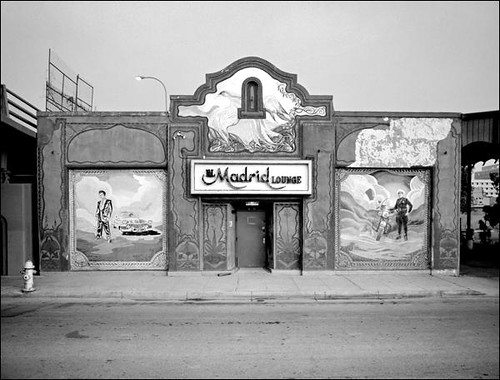
El Madrid was right around the corner from the house we rented. It looked like this, and still does.

We shot pool there, drank cheap beer and saw some mostly unmemorable bands and even a performance poet. The mural is killer, isn't it?

We also spent time at the Fat Chance Bar & Grill. There, we saw local bands including Cracks In the Sidewalk, whose bass player was incredibly hot, and A Murder of Crows, who kicked a large amount of ass.

Here's a 1986 video from public access TV of Cracks In the Sidewalk. They start playing around the 1:15 mark, and when they finish, another band comes on. The bass player doesn't look hot in this video, but trust me, she was.

Alas, the Fat Chance closed in 1997.

So there's a little taste of what I'm brewing up in my memoir.

Thursday, January 10, 2013

Selective Memory

I've long thought that I have a poor memory, but in working on a memoir about a road trip I took nearly 25 years ago, I've come around a bit to give myself some credit, and feel as though I've learned a bit about how my memory works.

First, let me state that there are times when my memory isn't all that great. My wife will tell me something about an upcoming plan for the weekend, and later that day I'll ask her, "What are we doing Saturday?" She just looks at me and says, "Weren't you listening to me earlier?"

I was listening, but I wasn't concentrating on what she said. Sometimes I truly didn't register the information, and can't summon it. Other times, I'm too lazy to think about the conversation and ask her to repeat what she told me. Occasionally, I'll burn a few brain cells and recall the information.

Unlike a lot of people, I can't blame my distraction on smart phone usage. As of this writing, I'm still living in Luddite Land, with a dumb phone. Rather, I have a hard time focusing on what other people are saying sometimes, instead letting my mind wander to thinking about some random shiny object or song running through my head.

Sometimes I distract myself during a conversation by telling myself, "Hey, pay attention to this!" which of course guarantees that I'm not paying attention. Weird, I know. Maybe it's ADD.

Still, in writing my memoir (working title: "My Four-Month Tour of Duty on the Battleship Patchouli") I've raised more details in my mind than I would've thought possible before I started writing the book.

My primary resources are a short journal and an audiotape that I kept during the trip, as well as two articles I wrote for my hometown newspaper (R.I.P., Farmington Valley Herald) to spark my memory. Still, those resources leave a lot of gaps, especially during our travels across Arkansas, Oklahoma, Texas and New Mexico, and our time spent living in Albuquerque.

I've reached out to my road trip buddies -- Andy, Pete and John. As I and listen to and read (via email) their memories of the trip, and as I spend more time writing and researching and thinking about the trip, memories pop up and fill in important spaces in the manuscript.

What valuable nuggets have emerged? Going to the stock car races in Albuquerque, and seeing a Powder Puff competition. Visiting a strip club in New Orleans featuring a girl on a swing. Getting chili-and-cheese hot dogs way too often at 7-Eleven. Riveting stuff? Perhaps not, but all these tidbits help paint a larger picture.

As I've asked questions of my road-mates, I realized they remember some of what I recall, but by no means have better memories than I do. Perhaps it's just because I've spent so much time on this in recent months, or maybe my memory isn't as bad as I thought it was.

I'm having a great time working on the memoir, primarily because it's a fun challenge to put together my history and to analyze who I was in 1988 and who I've become. And secondarily, I find it enjoyable because I've learned to give myself a break when it comes to my historical recall.

Now, please to enjoy Giant Sand covering Johnny Thunders:

Tuesday, December 11, 2012

"On the Road," again

James A. Reeves has written the road trip memoir I wish I could write.

Bastard....

Reeves recently published The Road to Somewhere: An American Memoir, which is a "photo memoir of one man’s journey through America that is as sprawling and chaotic as the country itself. Contains 55,000 miles and 416 colorful pages with a map and an index," according to the book's back cover.

I can't wait to read, and look at, this book.

According to the publisher's description: "While working at a design studio and teaching, whenever he could find a few days he would buy a ticket to anywhere cheap, rent a car, and drive in the direction of whatever towns struck his fancy — Truth & Consequences, Delta, Dinosaur — racing blindly through the back roads of the country."

Reeves took his trips between 2004 and 2009, taking tons of pictures along the way.

Here's a promotional video:

Some have compared Reeves' book to Jack Kerouac's seminal novel On the Road. As I've mentioned here a few times (May 25, 2012, "Inspiration," and October 2, 2012, "The Struggle"), I'm working on a memoir about a road trip I took with three friends in 1988. I compare our trip and the dynamic of the four personalities to the ramblings of Kerouac and his buddy, Neal Cassady.

Obviously, my book is very different from The Road to Somewhere. I took my trip 16 years before Reeve, and the photos that I took didn't come out because I was using a crappy camera and didn't know what I was doing even with a crappy camera.

But like him, I learned a lot about this country -- the good, the bad and the ugly -- during the four months I traveled from Connecticut to New Mexico and back. I also learned about myself, although many of those lessons didn't come until I'd started working on the book nearly eight months ago.

I continue to make progress on my book. I have begun filling in holes in the timeline thanks to email and phone correspondence with friends and family. And I've recently begun hammering all of it together into what I believe is the right format and order. Of course, I've had those thoughts before and ended up making changes, but that's just part of the process.

Monday, June 25, 2012

Party Like It's 1949

On Saturday, I hung out in Keene, NH, for the first time in a few years. The occasion was the annual WKNHers & Friends Summer Get Together, at which folks who worked for Keene State's radio station in the '80s and '90s, and those of us, like me, who consorted with them, ate, drank, were merry and passed around vials of Geritol.

All hopped up on too much of Jack Kerouac's 1957 novel, On the Road, in which he details numerous road trips he took with his crazy buddy Neal Cassady in the late '40s, and Neal's wife Carolyn Cassady's Off the Road, in which she writes about the trials and tribulations of her marriage, as well as her intimate relationship with Kerouac, I was anxious to make the two-hour drive to hang out with my buddies Pete and Ken from The Toastmen, as well as other good folks from college (and many who I didn't meet until after I graduated). I made an iPod playlist a few weeks in advance; that shows you how excited I was for a little overnight getaway.

The drive up went pretty quickly, with Janis Joplin's "Half Moon" kicking off my playlist:

As I approached Keene, the skies gradually darkened and the winds picked up very quickly. I called Pete on his cell phone and we discovered that we'd both hit town (he came from Portsmouth) at the same time. He was buying a guitar at Retro Music, so I told him to meet me at Cobblestone Ale House, which I just happened to be driving by as we spoke.

After one pint, I checked my voice mail and saw that Ken had called. I listened to his message and was bummed when he started out saying, "I've got bad news, I'm not gonna be able to make it to the party." Well, that's a bummer, I thought, and kind of lame.

"Because a tree fell on my house," was the next part of the message. Pete and I huffed it over to Ken's place as quickly as we could and couldn't believe our eyes.

We hung out with Ken and his wife and daughter for a while, marveling at the damage to the roof and the kitchen. While we were there, a tree removal crew and a contractor arrived to survey the damage and talk about getting the tree off the roof, putting tarps in place and making a plan for repair.

There was nothing Pete and I could do, so we went to the store, bought some beer, ice and steaks and headed to the party, which just happened to be right around the corner from Ken's house.

The party was a bit smaller than ones I'd been to in the past, but I had a really god time hanging out with my friends Mike and Lenore Smith; the hostess, Cindy, and her husband Bret; Mike and Nicole Caulfield; a guy named Jimmy who I hadn't seen in probably 25 years; and a few other folks.

(Nicole and her husband Mike, Pete, Bret and Cindy)

(Mike and Lenore Smith flank Jimmy Bensinger)

We listened to Mike C's '80s playlist, which included everything from Mission of Burma, The Smiths and New Order to Husker Du, Dinosaur and the Butthole Surfers. Great stuff!

I had planned to stay the night at Ken's, but obviously that plan got scuttled the instant a lightning bolt scorched the tree in his backyard and dropped it onto his lovely little ranch house.

Bret and Cindy offered to let me sleep at their house, but I decided I'd rather wake up in my own bed. So just before midnight, I tanked up the ol' Mazda 5 and hit the highway.

One of the tunes that got me home was fIREHOSE's brilliant cover of Blue Oyster Cult's "The Red and the Black":

I felt like Neal Cassady as I bombed through small towns in New Hampshire and Massachusetts, little traffic on the road, windows wide open and tunes blaring, except I wasn't "digging jazz" or making my way to Mexico or blabbering away to my fellow passengers. Otherwise, exactly the same.

I got home around 2:00, putting a bit of a scare into Beth, who wasn't expecting me until about noon. I didn't get enough sleep, but I was, as predicted, happy to wake up in my own bed.