Showing posts with label archeology. Show all posts

Wednesday, May 2, 2012

Diggin'

Maybe it's nothing.

Maybe, as one wag on Facebook wrote after I posted this picture on my timeline and wondered whether it was an arrowhead, Stone Age tool or a petrified shark's tooth, "It is a shard of rock that by chance is somewhat triangular shaped and looks like all the things you mentioned."

Maybe I let my imagination run wild. Maybe it's a coincidence. Maybe some kid in my neighborhood spent a day fashioning a triangle out of stone in order to teach himself geometry.

Maybe.

I've long been fascinated by archeology, "the scientific study of material remains (as fossil relics, artifacts, and monuments) of past human life and activities," as Merriam-Webster defines it. I don't recall what sparked my interest. Perhaps it was reading my parents' copy of Erich von Daniken's "Chariots of the Gods?" when I was a kid. Von Daniken theorizes that the Egyptian pyramids, Stonehenge and the giant head statues on Easter Island, among other artifacts and monuments, were produced by extraterrestrials or by humans with help from ET's.

As I've written before, the book also sparked my life-long interest in UFO's (see August 7, 2011, "Sucked Back In").

My other blog, The Backside of America, focuses on archeology in a completely non-scientific way. My fellow contributors and I share an interest in taking pictures of forgotten highway overpasses, abandoned factories, dilapidated barns, rusting cars, run-down diners, faded signs painted on old brick buildings, sanctuaries hidden in the woods, etc. and writing about them. Sometimes we just share our photos; other times we provide some insight into why we took the pictures, and the history behind the subjects.

Time machines don't exist. Therefore, the best way to travel into the past is through researching and understanding who our ancestors were, how they lived, where they lived, what they did, how they died, what they loved, what they hated, what they made, and so forth.

On my recent trip to New York City with my family (see April 23, 2012, "NYC Three Times"), I was surrounded by skyscrapers, traveled underground on subways, rode in cabs on jam-packed streets -- the total urban experience.

As much as I love being in Manhattan or Boston or other big cities, I find myself trying to imagine what the land beneath the concrete and metal looked like 500 years ago, when rivers flowed, trees swayed in the breezes, animals roamed freely and Native Americans lived in small villages and planted and hunted for their food.

Then, I think about what our world will look like 500 years in the future. Will it be a Space Age utopia, like we've been hearing about for decades upon decades? Will the population maintain a manageable level? Will there ever be a universal peace? Will we control greenhouse gases? If not, will humans die out, and Mother Nature reclaim the landscape

Bigger questions than I usually write about or think about, but ones that pop into my head from time to time. And when I stumble across something as simple as a triangular stone that may or may not be an artifact from an earlier citizen of my neighborhood, I can't help but be fascinated by how quickly things change in our world, and how quickly we forget those who came before us, and to learn from them.

Maybe all these thoughts are coming to me lately because, having recently turned 47, I'm starting to truly feel middle-aged. I listen to the music that my nearly-10-year-old son, Owen, likes -- trance techno -- and shake my head. I see an older man, perhaps 65, shopping at the grocery store and wearing sandals and sporting an earring, and I identify more with him. "I can see him flying his freak flag during the Summer of Love," I tell myself.

I look all around me everywhere I go and see everybody consumed by smart phones and I wonder about the questions that archeologists 200 years from now will have about all these gadgets, which, as cool as they may be now, will seem so primitive in the not-too-distant future.

And I wonder about my own legacy. Am I raising my kids the best way I know how? Will they turn out OK, and be happy with who they are and what they do? Will sales of my short story collection soar after my death? Will I ever put out that UFO concept album I've been talking about for years? And the companion novel? Will I publish the children's books I've been tinkering with for the last couple years?

Let's hope the answers to those questions are: yes, yes, yes, yes, and yes.

Wednesday, August 24, 2011

My Nascent Archeology Career


I've long been interested in archeology: I'm fascinated by the stories of discovery in Egypt's Valley of the Kings; Jordan's ancient city of Petra; the trove of material uncovered during Boston's Big Dig project; really, any place where scientists locate and delicately reveal pieces of the distant (and not-so-distant) past.

I subscribe to American Archeology magazine.

Here's some quick background on the above photo. When I was 14 or 15, two older kids in my neighborhood told my friends and me that they'd rummaged through an abandoned house close to the nearby railroad tracks. It was full of somebody's stuff -- lots of it, they said.

So my buddy Pat and I (and maybe his brother, Bryan) hoofed it down the tracks, then slid down a hill leading to a swampy area until we got to the house. Sure enough, the place was empty of people, but full of all the things that make up a life: boxes and cans of food; framed photos; clothes; magazines, books and newspapers; a mannequin (?); pots and pans.

I imagine we went back at least one more time, although I can't recall (it's been a looooong time). I don't remember when the house was torn down. In the early '80s, when I was 18, a road was built right near where the house had been, leading over the train tracks and into a new condo development.

While I didn't know the people who had lived in the now-abandoned house, the memory of walking through the detritus of their lives haunted me for quite some time. OK, maybe I wasn't dwelling on it in college, but through my 20's and into middle age (oh man, is that what 46 is?) I've continued to puzzle through the situation. Why did the owners leave behind everything? Were they forced to leave? Who were they? How long had they lived there?

I remember that the people in the pictures in the house were African-American. I let my mind wander to dark places when I thought about these unknown folks. Did racists from my hometown threaten the family, forcing them to flee? I doubted it, but I just had no clues as to what had gone on.

Fast forward to August 2011. I joined a group on Facebook called "I grew up in Simsbury, CT." I posted a question wondering if anybody knew anything about this abandoned house, and lo and behold, two people not only knew of the house, but had visited the old man who lived there back when they were teenagers.

They told me his name was President Little (what a name!) and that he was the son of slaves. One of them said he had no family to leave anything to when he died, which was why the house was left in the condition that my friends and I found it. The other Facebook commenter said, "President was a great man, and all the kids loved him."

Well, I was thrilled to uncover a piece of the puzzle. I had a name, and the fact that the man claimed to be the son of slaves (or that somebody remembered it that way) backed up my memory of seeing a black family in pictures in the house. A quick Google search turned up some basic genealogical facts. Turns out President Little's parents weren't slaves, as they were born in the late 1800's. But it's entirely possible he was the grandson of slaves.

I also discovered that President Little had five kids, and as best as I can tell, four of them were alive in 1981 when he died. It's possible that one or two of them are alive today. So why didn't he leave the house and his belongings to one of them?

As fate would have it, I had a trip to Simsbury planned for last Friday, August 19. I played in the 7th annual Ben Nascimbeni Memorial Golf Classic. I set out from home a bit earlier than I needed to in order to try and find anything at all at the site where President Little and his family had once lived.

I turned off Route 10 onto the road leading past where the house had been, and into the development. I walked back down the road, toward Route 10, looking for an entry point into the thick woods that shield the development from the road.

Finding no path, I just plunged in, camera in hand, not caring at all about the fact that I was wearing neat and clean golfing clothes. The going was a little rough and muddy, but within five minutes I stumbled across what I figured was the remains of President Little's abode.

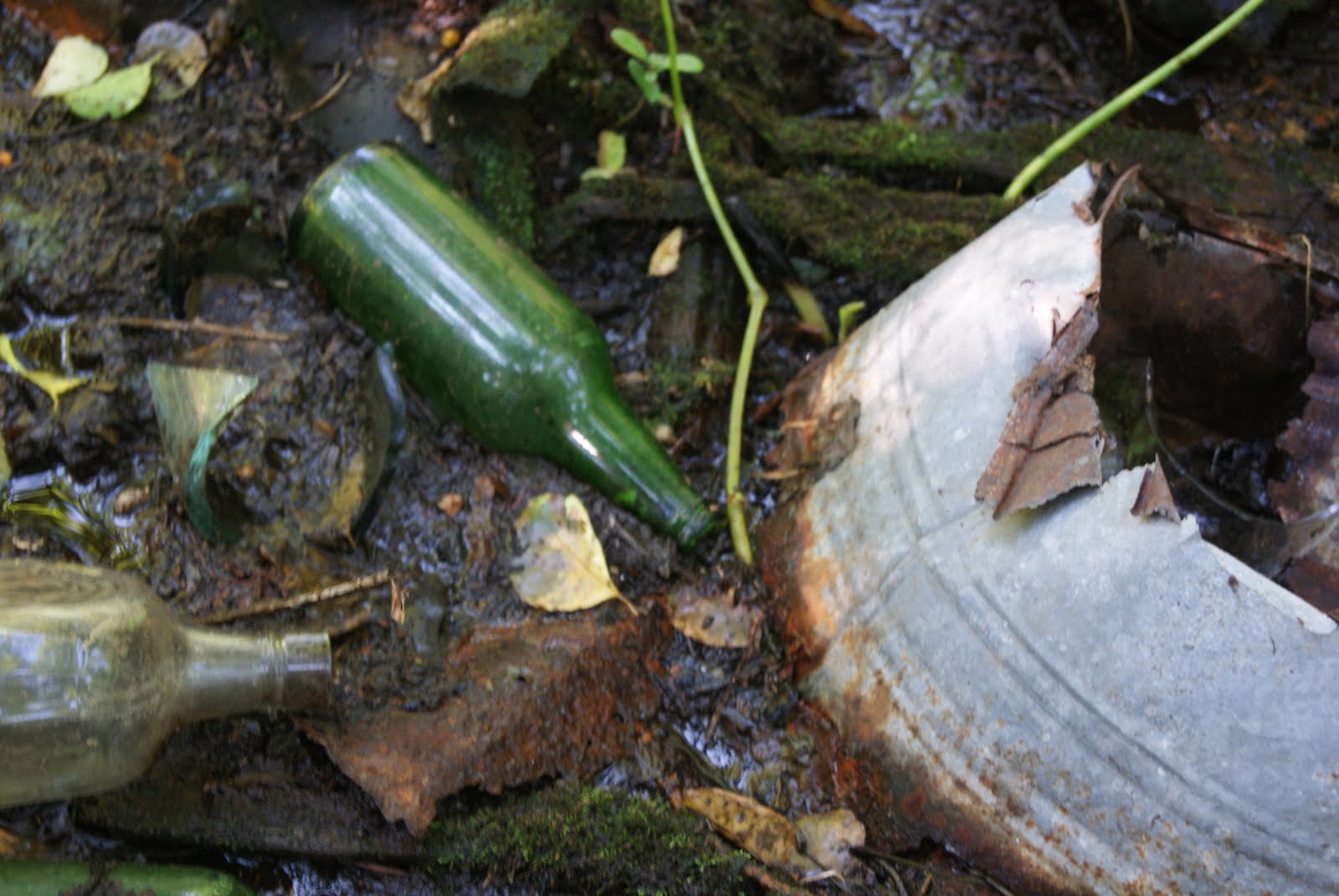
Upon my approach, I could tell I was in the right place. It looked like this:


I stepped carefully through the mud, and around the objects, and things began to come into clearer focus.


I was thrilled that I'd found this location that had been on my mind so often over the years. I was proud of myself for taking the plunge into those woods and so quickly locating the spot. These feelings were mixed with sadness, however, about the fact that somebody's life and belongings were slowly sinking into the muck. I was also shocked, frankly, that whoever had torn down the house had removed big items like furniture and appliances, but simply left behind these smaller items.

So what now? I'm not sure. I've talked in the recent past in the abstract sense of wanting to write a book about this house and its abandonment. Now that I've discovered the name of the man who lived there, and been to the site, strangely I feel less of a need to take on something as big as a book. Honestly, I never knew what form the book would take.

I do plan, however, on finding out as much information as I can about President Little, his family, the house, people who knew him, etc. And put together an article of some sort and try and find a market for it.

This project brings together so many of my interests: history, archeology, genealogy, my hometown, detective work. I can't say why this concept has stuck with me for such a long time. Encountering the abandoned house all those years ago made quite a mark on my psyche, and I've felt the need to solve the puzzle, even though I have just a very tangential connection to the people involved.

Stay tuned....