Showing posts with label book review. Show all posts

Saturday, February 6, 2021

Book Review: Radio Waves: A Post-Punk Novel

I first met Shawna-Lee Perrin in late 2010 at a release party for my short-story collection, (C)rock Stories: Million-Dollar Tales of Music, Mayhem and Immaturity. She and her husband, Dave, traveled south from the Granite State to Waltham, Mass., to hear me read from my first book in the back room of the Skellig Pub (R.I.P.). We'd been Facebook friends for a few years, as we had friends in common from our respective days at Keene State College.

Back then, I wouldn't have guessed that 10 years later I'd be in a band with Shawna, and that I'd be extolling the virtues of her first book, Radio Waves: A Post-Punk Novel.

For years, our friendship remained a Facebook construct, maintained largely through commenting on each other's photos, rants and YouTube clips. I learned that we had a lot of similar musical tastes (old-time country music, some punk rock and post-punk). At some point, Shawna posted about studying creative writing through the Mountainview MFA program. As she traveled along the path to writing her first novel, we communicated here and there about her progress. I was excited for her, as I am for any friend or family member who makes the leap from "Some day I'll write a novel/record an album/fill that canvas" to "I'm actually doing it!"

While she plugged along on her novel, I was working on the road-trip memoir that I've written about here over the years. We would occasionally check in with each other to see "How's it going?" Writing is a lonely craft, so community outreach is important.

Shawna and my college chum Ken also knew each other through various channels, and at some point discussed playing music together. Since our time playing in The Toastmen at Keene State in the mid-'80s, Ken had played with at least a handful of bands in Rhode Island and New Hampshire, honing his lead-guitar chops. I don't think Ken and Shawna ever jammed.

Fast-forward to the fall of 2019. Ken and I put the word out on Facebook that we were looking for musicians to join our newly formed combo, The Slade Wiggins Band. Shawna said she and her husband, Dave, were interested. They'd played in a few bands together over the years, she on bass and him playing banjo, guitar and fiddle. For our little combo, Dave offered to play drums, something he'd picked up in recent months. Ken and I were happier than a double-neck guitar is to be strapped around Jimmy Page's shoulders.

We jammed in November of that year, and the four of us clicked pretty well, musically and socially, as Dave and Shawna are two of the nicest, most easygoing folks you'll ever meet. In between working on a few originals and a few covers (Hank Thompson, Silver Jews), Shawna and I talked about our respective books, and offered to help each other any way we could.

Before too long, Shawna put it out on Facebook that she was looking for folks to read the latest draft of what would become Radio Waves, and I happily agreed to dig in. Her story grabbed me right from the start, as it is about music that I love and people who I can relate to. I offered some constructive criticism, which she happily accepted. I also sent a draft of my road-trip memoir to her, and she provided lots of great notes on it.

Now, Radio Waves is out! I'm so excited for Shawna, because I know how hard she's worked to write her novel, and to get it published. And the book is great, even better than the draft I read a while back. Shawna has infused her lead character, Viv, with amazing passion for music. She lives for post-punk, punk and New Wave bands, from Wire and The Clash to Blondie and The Ramones. But it's Joy Division that unlocks her soul.

Let me say this: you don't need to be a total music spazz like I am to relate to Viv's story. Radio Waves is a coming-of-age story, a love story, an adventure tale, a music history lesson and so much more. Set in 1979-80 in New Hampshire and London, the novel finds Viv in her senior year in college, working at the school's radio station and contemplating whether she's ready to get married, settle down and have kids. Her fiance, Adrian, seems to have their life together planned out, even though he doesn't really know what makes Viv tick; he calls her musical tastes "weird" and "upsetting."

Viv practically lives at the radio station. She has developed her strongest friendships there and risen up the ladder from a 17-year-old trainee to co-music director. She goes inside those graffiti- and sticker-covered walls when she needs to get away from the world when it all seems to much: Adrian pressing her on their forthcoming nuptials and transition to an "adult" life; her mother bombarding her with questions about wedding minutae.

In the midst of her young-adult crisis, she meets John, who is visiting his brother Noel, a freshman at Viv's college. The brothers are from England; John and Viv make an instant connection over music and quite quickly they fall into each other's arms.

I'm not going to write anything more about this book, because I want you to go and buy it and read it. You can get it here.

Here's a little taste of Joy Division, for those of you who aren't familiar with this influential British band, which lasted for just a few years in the late '70s and early '80s.

Monday, September 11, 2017

Bookin' It

I love to read but I'm not good at reviewing books. In junior high school I considered reading book reports to my classmates to be a fate worse than eating tofu-covered lima beans. Shrinking in my seat like an ashamed Rottweiler who's afraid to chase the mailman, I would agonize as student after student volunteered, hoping that somehow the teacher would exempt me. Of course she never did, and I never learned the lesson that going first means you get to kick back and enjoy as other kids stammer and turn red and tremble so badly their reports nearly tear in half.

In my adult years the fear of reading my work out loud has been replaced by the realization that I'm just not that good at critical analysis. I've always had difficulty plumbing the depths of long works of fiction, teasing out the symbolism, deciphering characters' ulterior motives or simply even remembering at the end of the book just what the hell happened in the first few chapters. These reasons attest to why I've never written a novel. I've diagnosed myself with executive function disorder.

Nevertheless, to coin a phrase, I've persisted. I've reviewed plenty of books here over the years, many of them non-fiction. Below you'll find links to three attempts. If you're so inclined, search the site for others.

April 4, 2013, Bill Bryson's The Lost Continent: Travels in Small Town America

January 20, 2012, Myles J. Connor, Jr.'s The Art of the Heist

July 24, 2012, Annie Proulx's That Old Ace in the Hole

I've come to you today with a somewhat different approach than the longer-form reviews I've done previously. I'm going with a quick-hit approach, offering up basic reviews and also a look at what's on my nightstand right now.

Also, there will be nepotism. Well-earned nepotism.

Earlier this summer I read Andrew Forsthoefel's Walking to Listen: 4,000 Miles Across America, One Story At a Time. The author of this memoir is young and freshly graduated from Awesome College or some such institution. He doesn't know what to do with his life, so he sets out from his mother's house in Pennsylvania on foot, a rucksack across his back, with the goal of simply talking to people along his route. He figures that he can learn from his fellow citizens how they make their lives work best, and apply those lessons to himself.

I really enjoyed Walking to Listen. Forsthoefel has an easy writing style and doesn't shy away from examining his own warts. The tales of kindness and generosity offered by his fellow Americans that he shares will make you think that in these polarizing political times there is hope for our nation.

Reading Forsthoefel's book was a dangerous thing for me to do, perhaps even brave. As regular readers know, I've been working, on and off, for several years on a road-trip memoir. So reading a really good book from a major publisher about trekking across the US of A is the sort of activity that could drop me into writer's depression. But instead I decided to take inspiration from Forsthoefel's book, go back and look at my work-in-progress and make it even better.

While I was the first member of my family to publish a book -- well, since you asked: (C)rock Stories: Million-Dollar Tales of Music, Mayhem and Immaturity -- I will not be the first to publish a memoir. That honor goes to my mother, Joan Bogert Brigham.

Published earlier this summer, her book, Invitation to Inner Light: To Love and Wisdom...an Essential Step for Personal and Planetary Peace, is part memoir, part travel guide to Peru and part revelation. The revelations for many readers will come in learning about my mother's spiritual path and how perhaps to follow their own, similar route to "opening to the sacred seed within." The book is about following your inner voice, which my mother tunes in via meditation, to realize who you are and how to realize your dreams and fulfill your destiny. She places great weight on love and learning how to discover the light that's inside each of us. This is my clumsy attempt to translate the message of Invitation to Light, as a person who is not at all spiritual and can't relate to many of the experiences my mother has had in her 85 years.

For me, the revelations in my mother's book were more personal. I had no idea that she'd yearned since she was a teenager for a meaningful spiritual experience. I never knew what motivated her to make not one, but two, trips to Peru in the 1990's. And I certainly didn't recall all that she'd told me about her transformative experience at Peru's Machu Pichu, the sacred and breathtaking ancient Inca city in the Andes mountains.

Additionally, I wasn't aware of just how important meditation, sounding and dream interpretation were, and still are, to my mother. Sure, I've heard her talk about all of these things all of my adult life, but reading it just makes it all the more evident and powerful. The message of my mother's book -- we as humans need to look inside ourselves to find the strength and courage to love ourselves and one another -- isn't unique. But given the tenor of our times, it certainly is a message that needs repeating. I can't express how proud of my mother for putting her heart, soul and, yes, LIGHT, into her book!

A few years back, I gave my mother a copy of Mark Adams's Turn Right at Machu Pichu: Rediscovering the Lost City One Step at a Time. I'm not sure whether she read it. More recently, I purchased a copy for myself, after reading and thoroughly enjoying Adams's Meet Me in Atlantis: Across Three Continents in Search of the Legendary Sunken City.

Now seemed like a perfect time to take Turn Right at Machu Pichu off my growing stack of books to read. And just as with his Atlantis book, I am getting tremendous enjoyment out of this one. Adams has a self-deprecating writing style that I both enjoy and employ myself. The basis of his book is retracing the route the Hiram Bingham III took in 1911 to expose Machu Pichu to the wider world. Adams ties his own trials and tribulations along the rigorous adventure to Bingham's pursuit, as well as to the history of the Inca people.

So far I'm loving it, and I expect that will continue.

Thursday, November 21, 2013

Book Review: "After Visiting Friends: A Son's Story" by Michael Hainey

Boy did I enjoy this book.

I'm tempted to leave my review at that, but that wouldn't do much to burnish my reputation as a writer. Using the word "burnish" might help, though.

Michael Hainey, now the deputy editor of GQ magazine, was six when his father died under mysterious circumstances in 1970. Growing up in Chicago, Hainey rarely talked with his mother about his father, or how he died. He ached to learn the details of his father's life, but was discouraged by his mother and other family members from doing so.

He graduated high school, went to college, got a job and finally, in his 30's, decided he needed to discover the truth.

Over the ensuing 10 years he sought out family members, his father's former colleagues, friends, neighbors and anyone else who might have a clue about how his father died. Hainey was stonewalled on a regular basis. He traveled great distances to meet people face-to-face. He used the skills he'd learned as a journalist to keep plugging away.

I really admire Hainey's writing. He uses short, crisp sentences to get across deep, often emotionally charged points. He is selective with his flashbacks, and extremely creative in their use.

"Here they come. People I know. People who know me. Blood, they say. Relatives, all. In big, wide American cars, they drive into my faded-asphalt lot. There's my uncle, Paul, my aunt Nancy; my godmother, Lorraine and her husband, Clarence. There's Uncle Harry, there's Aunt Sue. They are waving to me. I am one boy on two wheels, going in circles, not stopping. And there they go, one after another, to do what you do when a life stops. Coming to close the circle."

For the last 19 months I've been working on a memoir of my own. Currently I'm on the fifth draft, and I've been inspired by After Visiting Friends: A Son's Story. I've been cutting as much fat as I can, and making fewer words do more work.

My story is nowhere near as fascinating as Hainey's, though.

I don't want to give away too much. Hainey's father was a newspaperman in Chicago. Like his colleagues, he lived by a certain code, which called for keeping things close to the vest. Maybe that's just called being a man, I don't know. When he died, the senior Hainey worked the late shift at the Chicago Sun-Times and spent many an early morning drinking alongside his buddies at bars all around the Windy City.

One night he drops dead, at age 35. Years later, his son comes across obituaries written in the Sun-Times and other Chicago papers. He notices that things just don't add up in these life summaries. His mission becomes figuring out just how his father died, who he was with, and why everyone clams up when the topic arises.

I'm gonna leave it at that. Go read this book.

Wednesday, September 11, 2013

Book Review: "The Warmth of Other Suns" by Isabel Wilkerson

I abhor confrontation, whether I'm involved or just a witness. This isn't something about which I am at all proud. Well, except for the fact that this character trait has kept me out of fist fights. I'm the kind of guy who thinks of a snappy comeback well after the fact, or needs to do research to provide back-up to whatever point I was trying to make earlier. I'm just not a good debater. Let's not get into the psychology of this.

Nearly 20 years ago I worked as a proofreader at a Boston accounting firm. The work was extremely dry, the work environment was fairly buttoned down, and my fellow employees were mostly young conservative types. Most days, a bunch of us younger types (the junior accountants, receptionist, interns and me, although I was a few years older than most of them) would eat lunch in the conference room.

Most times, the conversation revolved around clients, or weekend antics or local sports. I spent much of the time hunched over the Boston Globe while I ate. A few of the young dude number crunchers used to fight over my sports pages.

One day the conversation shifted from the usual topics to something more controversial, although I might have been the only person who considered it so. Well, I suspect I wasn't the only one, but certainly nobody spoke up when a few people, especially the receptionist, started bad-mouthing black people.

I don't recall how the subject came up. Could have been a report in the paper about gangs. There have always been gangs in Boston, including the infamous Whitey Bulger and his associates, but in the mid-'90s, as today, many of the gangs are made up of young, black men. In September of 1995, a gang prosecutor was assassinated in broad daylight.

The only comments I recall from this conversation came from our receptionist, a nice woman named Maria, who was, like me, a few years older than the recent college grads who we ate lunch with. I liked Maria. She was easy to talk to, good at her job, if a bit ignorant of world affairs at times.

A proud daughter of Italian immigrants, Maria wondered that day about why black people had such a hard time moving up in the world, when her family and other Italian-Americans managed to find their way in the world and be successful. It was obvious that in her opinion, black people just weren't trying hard enough, or had some deficiency that was holding them back.

Listening to her, I got that feeling that I get when I'm uncomfortable with a conversation or am witnessing an argument or physical confrontation. My nerves jangled, my skin got hot and my brain seethed with disgust. But I didn't say anything, couldn't think of what to say that would get my point across without making Maria feel bad. See, I don't ever want to make people feel bad. Because then they'll say something back, and either I won't have an answer, or I'll get too mad too quickly and end up saying something nasty.

I've thought many times over the years about the things Maria said. I've come up with replies that would've, at the least, made Maria think for a few seconds about what she'd said.

Now, all these years later, I have an answer for her. Sure, it's more than 500 pages long and has taken me weeks to read, but Isabel Wilkerson's The Warmth of Other Suns: The Epic Story of America's Great Migration provides irrefutable proof of the misery that black people endured for the 100 years after slavery ended, at the hands of white politicians, lawmakers, law enforcement, employers, everyday people on the street.

"You wanna know why black people have had so much difficulty getting ahead in America?" I would ask Maria now. "Because white people treated them like shit at every possible turn, and that was in the good times. Lynchings, Jim Crow laws, unfair wages and housing opportunities, refusal to allow them to drink from the same fountains or ride in the same train cars (and countless other methods of separate and unequal treatment) -- setting up an entire system designed to keep black people from making anything of themselves."

None of this information is new to people who have any clue about the history of race relations in the United States. But when you read page after page of first-hand accounts of the unimaginable suffering that the descendants of slaves went through, it makes it far too real.

But Wilkerson's book is so much more than just a recounting of terrors and heartbreak. The author interviewed more than 1,200 people in order to get as complete a picture as possible of what people in different parts of the South did to escape North or West and make a new life. Out of all of these folks, she chose three as the "leads" in the story of millions of people who made the brave and sometimes heart-rending choice to leave their homes and take a chance in someplace new.

Ida Mae Brandon Gladney left Mississippi and went to Chicago; George Swanson Starling fled Florida for New York City; and Robert Joseph Pershing Foster bolted Louisiana for Los Angeles.

Each had a different reason for leaving: Gladney and her husband escaped after somebody close to them was beaten for committing a crime that turned out never to have occurred; Starling felt threatened after agitating for better wages in the citrus groves; and Foster felt stifled in the Deep South and fulfilled his longtime dream of going to Hollywood.

All of them faced discrimination in their new cities, and hard times getting started and becoming even a little bit successful. And while they missed the people, food, culture and landscapes of their hometowns, they never regretted migrating away from the brutality of the South.

Wilkerson tells their tales with such intimacy and beauty, providing incredible details at every turn of their lives and hardships and triumphs. I felt so connected to each of the three protagonists, and learned so much about a huge chapter of this nation that I knew next to nothing about beforehand.

I have no idea what, if anything, Wilkerson is working on now. I imagine she's got something in the works. Whatever it is, I'm sure I'll read it.

I've gone on too long. Just go read the book.

Wednesday, July 17, 2013

Vacation reading?

I don't consult best-seller lists, and rarely read book reviews, whether they be in the Boston Globe or Entertainment Weekly, the only two publications I read regularly that offer such things. And when the hot weather descends and it's time to hit Cape Cod for a week, I don't confer with summer reading suggestions either.

What did I read last week while hanging out on the Cape with Beth, the kids and Beth's family? A light mystery or upbeat biography? A collection of humorous short stories or a memoir about how swimming with dolphins can change your life? Not quite.

I took on Stewart O'Nan's The Circus Fire. An easy, breezy read this ain't.

The book, which came out in 2000, is an achingly complete reconstruction of the events leading up to, during and after the 1944 circus fire in Hartford, CT, that killed 167 people.

I forgot we had the book, and I don't remember who gave it to either Beth or me. I found it in the attic a while ago and put it in my pile of "to read" books. I'd cruised through August Kleinzahler's memoir, Cutty, One Rock, recently, and wanted to take on something a little weightier.

I could've chosen Isabel Wilkerson's The Warmth of Other Suns, but I knew I'd never finish it in a week. That will be my next book, after Bill Bryson's I'm a Stranger Here Myself: Notes on Returning to America After 20 Years Away, which is a collection of essays that are funny, insightful and easy on the brain.

O'Nan (author of, among many other books, Faithful, a chronicle of the Red Sox' historic 2004 season, which he co-wrote with Stephen King) obviously did a lot of research for The Circus Fire, his first major nonfiction work.

At times, I got lost in the minute details he provides about various victims, both before, during and after the fire. But for the most part, I was engrossed by the history of fires in the circus industry, the details of circus life, the individual stories of courage and heartbreak, and the amazing work investigators did to try and identify victims and solve the case.

I was born in Hartford's St. Francis Hospital in 1965, and grew up 10 miles north of the city. I recall hearing about the fire during the course of my life, but I never knew just how awful it was. Here's a video that will give you just a very basic idea of the horror:

This book is obviously not for everyone. It's a tough read a lot of the time. O'Nan gives in-depth descriptions of the horrendous scenes of struggle and escape from inside the tent; the condition of the survivors and the dead; the agonizing attempt by family members to identify the charred and mangled bodies at the makeshift morgue.

But as a history lesson, it's fascinating. O'Nan details how negligence on the circus operators' parts -- ranging from narrow entrances/exits to animal chutes that blocked easy egress -- led to so many people dying. He also spends time analyzing how people react to unexpected, traumatic situations such as fires, and how they may see flames but since it's so out of the ordinary, their brains don't register the situation right away. O'Nan also talks about how in mob scenes too many people act only in their own interest, and how they too often blindly follow what everyone else is doing, instead of considering other options of escape.

Unfortunately not enough people have learned the lessons that the circus fire offered, as evidenced by events such as the Beverly Hills Supper Club fire in Kentucky in 1977, and The Station nightclub fire in Rhode Island in 2003.

Thursday, May 30, 2013

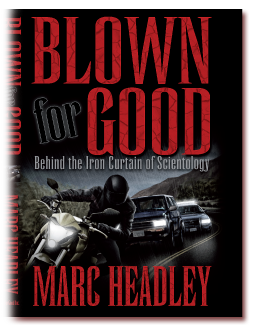
Book Review: "Blown for Good" by Marc Headley

I will tell you right off the bat that Marc Headley's Blown for Good isn't well written. Headley too often gets bogged down in Scientology jargon and abbreviations, uses way too many exclamation points and can be sloppy, repetitive and ham-handed.

But the story he tells is utterly fascinating.

Like many folks, I was aware before reading this book that Scientology was a weird business masquerading as a religion. I knew that big-name actors such as Tom Cruise, John Travolta and Kirstie Alley were Scientologists, alongside lesser-known names such as the musician Beck and the actor (and Beck's brother-in-law) Giovanni Ribisi.

I knew little, however, about how the everyday Scientologist lived. Headley joined Scientology when was 15, because his mother did. He attended their schools and before too long, moved into one of their West Coast facilities and began working there.

At age 16, Headley became the treasury secretary for the group's Association for Better Living and Education International (ABLE Int -- Scientology loves its acronyms), which controls, among other things, four of Scientology's non-profit organizations.

At age 16, he's in charge of finance for a major organization, but like most people living at Scientology's heavily guarded compound in California, he's unable to have a driver's license.

The fact that Headley, and countless others in the book, are put in charge of projects and departments that they're clearly not qualified for, amazes me. I believe that head Scientologist David Miscavige runs the system this way so that he can come in and look like a genius when his underlings screw up, and then bust them down to slave-level jobs so it takes them a really long time to climb the ladder.

In order to move up the food chain, members are required to take course after course based on the teachings of Scientology's founder, L. Ron Hubbard. They are also regularly "audited," during which they are grilled for hours while hooked up to an E-Meter, which is similar to a lie detector. If they exhibit physical reactions that lead the auditor to believe they're lying, or hiding something, then they don't pass, and have to study some more.

Headley recounts being audited a number of times by Cruise, when the "Top Gun" actor was earning his stripes with Scientology. Members who don't live in one the group's compounds pay thousands of dollars for courses and auditing. This is how Scientology makes its money. Well, that and selling books and videos to members.

I was just astounded at how much of a cult Scientology is. Those who are members of what's called Sea Org wear matching uniforms, live in Scientology-owned housing, often work 100-hour weeks for little or no pay and are warned that if they ever try to leave, they will be cut off from their families who are still in the "religion." Short for Sea Organization, the name Sea Org is rooted in Hubbard's late '60s initiative to teach Scientologists aboard three ships, an effort that many attribute to Hubbard's need to evade the prying eyes of the U.S. Food and Drug Administration and Internal Revenue Service.

I could go on and on about the mental and physical torture that Sea Org members, and those living in other Scientology encampments, endure, and about how bizarre their litany of courses and organizations and books and films are, as Headley describes them. But I feel as though in doing so I would drive myself crazy.

That's how I felt while reading this book: that I was going insane. The Scientology culture is so claustrophobic and controlling and filled with meaningless jargon -- and I haven't even gone into their belief that all humans have lived past lives going back trillions of years!

I'm sure there are other, better written accounts about life behind Scientology's barricades. I recently added Janet Reitman's Inside Scientology: The Story of America's Most Secretive Religion to my Amazon wish list.

If, like me, you get consumed by labyrinthine issues and outraged by how the I.R.S. in 1993 granted tax-exempt religion status to Scientology basically because the revenuers were exhausted by a barrage of Scientology lawsuits, then read this book. Or check out Reitman's book and let me know how it is.

Maybe this video of Supreme Scientolgist David Miscavige and Tom Cruise will convince you to buy a book:

OK, I just watched that video and wow, is Tom Cruise an idiot? Is he a robot? I think he's trying to come across as enthusiastic and serious and committed, but I don't see it or hear it. All I can do is shake my head.

Thursday, April 4, 2013

Review -- The Lost Continent: Travels in Small Town America

Reading a memoir about traveling across America, while simultaneously working on the same type of book, can be dangerous, especially when that memoir is written by Bill Bryson, who, in addition to being a best-selling author, is the chancellor of England's Durham University.

The book -- The Lost Continent: Travels in Small Town America -- is the second of Bryson's I've read, the first being A Walk In the Woods: Rediscovering America On the Appalachian Trail. I really liked the Appalachian Trail book, in which Bryson walked long stretches of the at-times grueling, world-famous trail that runs for approximately 2,200 miles from Georgia to Maine (I wrote a little about the book, and my childhood spent playing amid the trees last year; see February 13, 2012, "Woods").

In A Walk In the Woods, Bryson spins a great tale of traveling with an out-of-shape friend, who provides comic relief. Bryson's descriptions of the wonderment, hardship and fear they faced during their adventure are terrific, as are his portraits of the landscapes through which they pass.

There are times when he gets a bit grumpy about things, understandably so given the challenge he set out for himself. And he gets a bit self-righteous about preservation at times. But overall, I really enjoyed the book.

So I had high hopes for The Lost Continent.

And I was somewhat let down. Sure, Bryson's trademark wit and self-deprecation are there. And his descriptions of the places he visits and travels past, and of people whom he meets, are vivid and funny. But there's a meanness to this book that I wasn't expecting.

Bryson was born in Des Moines, Iowa, in 1951. After dropping out of college and traveling a bit through Europe, he moved to England in 1973. He got married, and he and his wife briefly moved to the States. But in 1977, he moved back to the UK. In 1995, he, his wife and kids moved stateside, to New Hampshire. Then, in 2003, he went back across the pond.

He wrote The Lost Continent during two trips across the States in 1987 and 1988. At that point, he'd been in England for a decade, and was obviously used to the people, the culture, the history, the food, the states of entertainment, retail and travel in the Old Country.

So it's understandable that he'd compare things between the New World and Europe. In the book, he rarely makes direct comparisons between the two worlds, but his harsh statements about how fat and boring he finds most people in the States, and how disappointing he finds many of the points of interest that he visits make it plain that he believes his native land comes up short when held against England, et al.

American are fat. They're stupid. They don't care about real history, only about fake representations at sites designed only to separate you from your money. There's too much landscape in between towns out West. Southern people speak too slowly. On and on he goes.

I'm not gonna lie to you: when I traveled across the country in a van with three friends in 1988 I made many of these same observations. But I expect a world-class writer to do a better job, to get off his high horse and engage with people, and find the stories behind the facades.

Still, I found enjoyment in the book. Bryson's a great writer, funny and observant and quite capable of tying his road trip experiences to moments from his childhood. In fact, the comparisons he draws between trips he took with his parents and siblings to some of the same locations he revisits as an adult, are some of the funniest and most poignant in the book.

Evidently, he returned to Iowa after his father died, and then took the road trip before flying back to England. It makes sense that the stories about his father and family trips are so well done.

I found myself wishing I could travel to some of the places Bryson visited, as well as to revisit some of the spots that I'm writing about in my memoir.

Unlike Bryson, when I traveled from Connecticut down to Florida, across to New Orleans, up to Memphis and out to New Mexico, I wasn't planning on writing a book. Sure, I kept a very basic journal and recorded some conversations on cassette tape, but 25 years after the fact, those sources aren't as complete as I wanted them to be.

In reading Bryson's cross-country tale, I'm jealous of the detail he includes, and the seeming ease with which he makes me laugh. Honestly, though, I'm doing a better job than I ever could have imagined with my memoir. I've spent 11 months on the book, and have arrived at a fairly complete picture of the trip I took, and how I felt about things while on the road. I've also managed to tie in other events from my childhood and from high school and college into the whole affair.

So, I recommend the book, but with the above caveats. And I look forward to reading I'm a Stranger Here Myself: Notes On Returning to America After 20 Years Away, Bryson's book about returning to the U.S. with his family in the mid-'90s.

Thursday, August 16, 2012

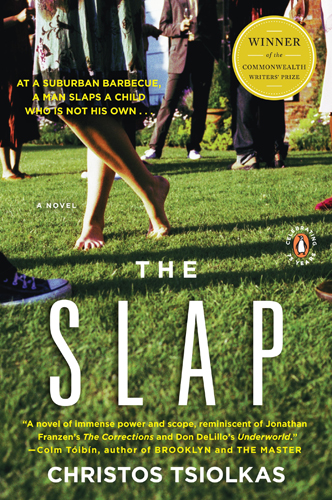
Review: The Slap

The Slap is another paperback I picked up for free at Newtonville Books after buying a full-price hardcover (see July 24, 2012, "Review: That Old Ace In the Hole").

I'd never heard of the book or its author, Christos Tsiolkas, but I liked the premise: a man slaps somebody else's child at a backyard barbecue, and as a result, a group of friends, acquaintances and family members question their parenting abilities, their cultural differences, their ideals and their relationships to each other.

Plus, it's an Australian tale and who doesn't love the Aussies?

As with the last book I read, Annie Proulx's "That Old Ace In the Hole," I feel that this book could've used a heavier edit. What's wrong with a novel that's under, say, 400 pages?

As someone who self-published a book ((C)rock Stories: Million-Dollar Tales of Music, Mayhem and Immaturity) that needed better editorial oversight, I know of what I speak. I had spent so much time getting the book ready for publication (10 years, give or take) that I couldn't stomach the idea of someone telling me where to make changes, or questioning the ideas in my book.

But if you're working with an actual editor and publisher, your book should be tighter than Tsiolkas's book. Still, I enjoyed his story and his method for presenting the multitude of difficult and intricately woven issues.

There are eight chapters, each one told from the perspective of a different character. I was impressed at Tsiolkas's ability to see life from so many different angles, both male and female, young (18) and old (69), and make each one seem true to life.

I thought he did an especially good job with the internal monologues of each of the characters. As someone who does a lot of self-talking (what probably appears to the outside world as crazy talk), I can relate to the world of inner thoughts, and how different that realm is to the persona we put forward.

And the view into the various cultures of Australia -- many of the characters are Greek immigrants and their children and grandchildren -- was fascinating. How do the Greeks deal with each other, and the aboriginal natives, and those of English descent? And what are the conflicts among friends who are Christian, Muslim, Hindu or atheist? Good stuff all around.

I know this isn't the most thorough review, but I started this a while back and just want to finish it up, so in conclusion I'll just say that I recommend the book.

G'day!

Tuesday, July 24, 2012

Review: That Old Ace in the Hole

Newtonville Books is a great local store. When they were actually located in my adopted 'hood of Newtonville -- before their move to the tonier Newton Centre -- they for a time offered buyers of hardcover books a great deal: a coupon for a FREE used paperback.

I picked up a bunch of freebies through that offer, a few of which I've read. This week I finished Annie Proulx's That Old Ace in the Hole.

Proulx is well-known and highly regarded. She won the Pulitzer Prize for The Shipping News, which I thoroughly enjoyed, and garnered recognition for her 1997 short story, "Brokeback Mountain," which Ang Lee turned into an award-winning film in 2005.

So after pawing through lots of books by authors I'd never heard of, I was excited to find Proulx's 2002 novel about a young man sent by his new employer to the Texas Panhandle to scout locations for hog farms.

I have to say, though, that the book left me somewhat unfulfilled, as though I'd ordered the Lumberjack Special at my local diner, and instead of Canadian bacon on the side they gave me veggie bacon strips (side note: why hasn't anybody copyrighted Facon and turned it into a viable commercial product?).

Proulx fills the book with incredible descriptions of the Texas landscape:

And it was crazy country too, some of the flattest terrain on earth, tractor-chewed and rectangled, rugged breaks and plunging canyons, sinister clouds too big to see in one look, rusty rivers, bone white roads and red grass -- the oddly named bluestem."

And she populates the book with loads of colorful characters with even more colorful names, such as Freda Beautyrooms, Rope Butt and Ribeye Cluke. As a guy who discovered a love for writing in second or third grade by making up stories featuring the most ridiculous names I could think of, I chuckled at each of Proulx's way-out character names. But eventually I found them a distracting device.

The protagonist, Bob Dollar, has an appropriately generic name, as he really doesn't displace much water in the story, but seems only to serve as a sounding board for other people's opinions and ideas.

He never cares about his job at Global Pork Rind, understandably. But he feels a sense of loyalty, which he attributes to his not wanting to abandon his responsibility the way his parents left him behind as a child, with an uncle, when they took off for Alaska. The corollary just doesn't work.

I was sorely disappointed that this book just didn't seem to ever really come together. I felt as though Proulx kept stringing things along -- plots, character development, scene descriptions -- because she didn't really know how she wanted to end it.

And when the ending did come, it was with a whimper, not a bang, which I guess is appropriate given how dull a character Bob Dollar is.

Now, I'm not gonna lie to you and tell you that I didn't enjoy this book at all. I wouldn't have plowed through its 359 pages otherwise. But I wanted the book to be great, not just OK. I wanted there to be a big surprise or shock here and there, but there really wasn't.

I guess that's why I found this book in the used section, and got it for free.