Tuesday, October 2, 2012

The Struggle

Like all writers, I struggle. And of course I wage those battles alone. I can't blame my boss or coworkers if I don't like an idea. And if I forget what a character did or said 20 pages earlier, I can't digitize an intern and send him into my laptop to figure it out.

And when reading works that go back years, even decades, I have no one but myself to blame for shoddy workmanship and blatant stylistic rip-offs. I was reminded of this when I recently stumbled across a copy of Frog Spit, a 'zine I published back in the '80s.

I wrote two stream-of-consciousness stories that were such obvious efforts to emulate Hunter S. Thompson (R.I.P.) that I found it embarrassing. And I was the only one in the room.

I do a lot of writing these days, between this blog and my other one (The Backside of America), and various book projects that I'll describe below. While none of my writing is perfect, I think that I've honed my craft in recent years simply by doing more work.

I also managed to refine my writing during my time at the late, great Webnoize (R.I.P.), and while writing my first book, which I published nearly two years ago.

I spent 10 years writing, rewriting, editing and self-publishing that book, (C)rock Stories: Million-Dollar Tales of Music, Mayhem and Immaturity. Sure, there were long periods where I ignored the stories, but I put a lot of work into the book.

I have a hard time editing on a computer, so I printed out the stories and went through them with a red pen, deleting, copy editing, writing new chunks of plot or character development.

Because the stories were related, and featured recurring characters, I needed to keep straight in my head who had done what, in order to make sure there was continuity. I had a hard time with this, and realized near the end of the process that I should have used two or three pairs of eyes to review and edit the book.

But I was reluctant to ask friends or family, because I wasn't confident in the stories and my abilities, and thought that if these reviewers questioned things too much I'd crumble and never finish the book. So I kept all the responsibility to myself, which wasn't smart.

I was happy with the published version of the book, but know that it could have been better if I'd been willing to put myself out there and let people judge it and critique it.

I learned my lesson, and since trying over the past few years to enter the children's book market, I've allowed friends and family to see drafts of stories. I haven't published a book yet, but I'm working with an illustrator on my latest, and feel confident that the book will hit the market eventually.

I'm excited about children's books. If my illustrator and I can get the first one published, I have a series planned. The books are very basic, but would fill a niche that I believe is under-served: easy, fun-to-read stories about subways.

While children's books and short story collections are obviously not easy to write, I find them much easier to do than novels.

I've begun three or four novels, but haven't finished one. The first was about a group of college friends going away for a weekend together, and that's about all I remember. Another effort surrounded a college band, based very heavily on my own such group.

My latest effort, which I began during National Novel Writing Month nearly five years ago, was about UFO's, road trips, government conspiracies, anti-corporate action and, of course, love.

I had a grand vision to write the novel and sell it packaged with a concept album that had actually spurred the novel. I haven't gotten very far on either account, and have come to realize in recent years that I may just not be a novelist.

I'm not giving up, so much as realizing that my brain just doesn't operate the way it needs to in order to keep track of all that goes into a novel: great character development, plot twists, strong descriptive language, recurring themes that move the story forward, and so much more.

I write best with a strong framework. I thought I'd established such a thing with my last attempt at writing a novel. Unlike with previous attempts, I'd made an outline based on the concept album.

But once I started writing, I just took the story off in all sorts of unexpected directions, which is OK, but I had a hard time reeling it all back in and pounding it into shape.

For now, I don't need to trouble myself with thoughts about writing the Great American Novel.

I continue to plug away on my road trip memoir, which I've mentioned before (see May 25, 2012, "Inspiration"). The linear narrative of the book is done, and I've got a plan for filling in details by getting in touch with the guys with whom I traveled.

There are other elements I'm adding, however, that need work. I write a lot about my childhood, and my life since the trip, especially the more recent years since my kids were born.

But all that information exists, so I know I can coax it out of my brain and onto the page. And I realize that I'll need people to read the book ahead of time and guide me to making it the best possible book it can be.

I just hope that in 10 years I don't look back on my books and think that they're total crap.

Wednesday, September 19, 2012

Remembrances of Big E's Past

While walking past a leather goods tent at the Eastern States Exposition earlier this week, I flashed back to two belt buckles I had as an awkward teenager. One was heavy, made of dark metal in the shape of an 18-wheeler; the other was a bright oval with a red sky, blue ocean and a ship commemorating my love for the band Kansas.

I'm pretty sure I purchased both of the buckles at the fair.

I loved big rigs. I watched "BJ and the Bear" and the "Smokey & the Bandit" movies. I knew all the types of trucks, from Peterbilt and Kenworth to Mack and International Harvester.

I also dug Kansas, they of "Dust In the Wind" fame. I didn't like that song, though. My sister gets credit (blame?) for turning me on to Kerry Livgren and company. Five years older than I, she owned Leftoverture, which featured the well-known "Carry On Wayward Son."

I believe I bought the band's next album, Point of Know Return. In addition to the aforementioned "Dust In the Wind," the album features the title track, which I liked a lot. The belt buckle scene I described above was based on this album's cover art.

I thought both of the buckles were really cool, which goes some distance in explaining why I didn't have a girlfriend in high school.

I hadn't thought about those accessories in a long time, but then again, I hadn't been to the Big E, as the exposition is called, in at least 30 years.

I took the kids to the fair on Monday. They had the day off from school in recognition of the Jewish New Year, Rosh Hashana. We met friends who'd managed to arrive nearly an hour before us by virtue of taking the "right" bridge across the Connecticut River into West Springfield. We ended up on the "wrong" bridge and waited in traffic for almost exactly the same amount of time (an hour and 20 minutes) as it had taken us to drive from Newton to Springfield.

The weather was perfect -- bright and sunny but just short of being hot. As soon as we met our friends, we sat down for lunch, to power up for all the rides I knew Owen and Amelia wanted to do.

While there were plenty of options for lunch, ranging from burgers and fries to something called the Pot Roast Sundae ("Sunday Dinner In a Bowl"), I opted for a bratwurst sandwich with sauerkraut, and a Spaten Lager to wash it all down.

I did not opt for this:

After we digested, the kids made their way to a handful of "house" amusements, not so much haunted places, as themed variations on the same thing: you walk across rope ladders, and past fun-house mirrors and avoid other obstacles.

They also, during the course of the afternoon, took in the Ferris wheel, a few sets of swings, bumper cars, a carousel and a few games. Owen even popped a few balloons with darts to win a little stuffed animal for Amelia.

The kids had a great time with their friends, Walter and Rory, and I enjoyed hanging out with their parents, Ray and Inez. I was thrilled to skip most of the rides, other than a small swing with Amelia, and the carousel.

I was proud that Owen decided to join Walter and Rory on the big crazy swing ride. He was unsure, but bucked up and enjoyed it. I jacked up the effects on this photo, but I really like how it came out.

After almost four hours, the kids needed some ice cream. While they ate, we got out of the sun and into an arena to watch some draft horses pulling weighted sleds.

I could've spent a lot more time there, but it was getting late, and we had to get home for dinner and bed, as the following day was a school day.

While walking around the fairgrounds, I was telling Ray about how when I was 12 or 13, I'd come to the Big E with my mom, specifically to see Joie Chitwood's Thrill Show, with special guest Catherine Bach -- Daisy Duke from "The Dukes of Hazzard."

Here's a quick sample of Chitwood and his boys in action:

I enjoyed both the thrill show -- with the drivers going long distances on two wheels, and gunning through flaming hoops and doing other crazy things -- and seeing Daisy. If I'd only been able to show her my belt buckle, I know she would have fallen for me.

The fair runs through September 30; I highly recommend it.

Friday, September 7, 2012

Radio Clash

I can't get Flo-Rida's oral-sex request song, "Whistle," out of my head, and I blame summer camp counselors.

I mark the beginning of the end of my children's pop music innocence as Friday, August 10. That day I drove them to Connecticut for a long weekend visit with my family. There was a lot of traffic, and it was raining, so the trip took an extra hour. During those 150 minutes, Owen and Amelia demanded (OK, strongly requested) to listen to various pop radio stations. Because I'm a nice guy, I obliged.

Most recently, Owen had been into electronic music that he'd heard in the background of various Mario Kart-centric videos on YouTube. While I wasn't crazy about some of the cyborg-like vocals and manic guitar and synthesizer parts, the songs were harmless.

But then the high school and college kids staffing the camp where Owen and Amelia went this summer turned the kids onto the likes of Nicki Minaj, Maroon (read: Moron) 5, Katy Perry and Flo-Rida, by way of local radio they played during art and music classes.

So now, whether in the car or at home, all of us are singing/whistling along to Flo-Rida's extremely popular song, only the two adults in the scene having any clue what the song's about. Check it out:

I suspect Owen has stumbled across this video, I'm gonna do my all to keep Amelia away from it. Yes, I know. I sound like an anti-Elvis parent from the '50s, or a grown-up who banned the Beatles from their house in the '60s.

That's what parents do: try to shelter their kids as much as they can, while simultaneously encouraging them to explore the world.

While Flo-Rida's song is the worst offender in terms of lyrical content, there are plenty of other songs where artists or their rapper guests drop bleeped-out F-bombs and s-words. Owen knows what these words are, of course, and thinks it's funny. He points out when the words are digitally edited over.

I listened to plenty of commercial radio when I was a kid. And of course I liked it when songs had bad words that were edited out, such as in Steve Miller's "Airliner," when the phrase, "funky shit going down in the city" was changed to "funky kicks...."

I understand how this works. But I also recognize that my job is to try and keep my kids from becoming foul-mouthed louts who teach other kids about F words that end in "uck" and "ellatio."

I try to convince the kids to listen to my music, something I've done since they were babies. It used to be easy, of course, to just let my iPod run and we'd listen to, dance to and play air guitar to whatever came on.

A few years back, Owen took a shine to indie rockers Chin Up Chin Up, as well as one of my all-time favorites, The Police.

But Owen's 10 now and developing his own tastes in music, which unfortunately at this point don't include rock. So I guess I need to do my best to monitor what he listens to and try and steer him toward the better commercial stuff (whatever the hell that is).

Simultaneously, I need to convince Amelia to listen to safer "girl stuff" like her copy of the "It's My Party!" CD of covers of '60s tunes. In the last few days, I've gotten her to listen to some Deee-Lite, so that makes me happy.

Yeah, I know, I'm like Sisyphus rolling the rock up the hill, or the idiot who opened Pandora's Box. But if I can remove just one pop song from Owen and Amelia's playlists in favor of the Flaming Lips or the B-52's or something sorta cool, then I'll consider it a victory.

Monday, September 3, 2012

End of Summer

We've had a good summer here at Casa de Brigahan, but I'm ready for summer to end.

The first eight weeks went by fairly smoothly -- with Owen in camp for seven weeks and Amelia for most of that time, plus a week on the Cape. I cruised along on my children's book and my memoir, took a bunch of pictures for my Backside of America blog, and got stuff done around the house.

But camp for both kids ended two weeks ago, and while we've had a lot of fun since then, last week dragged quite a bit at times. Owen and Amelia are ready for school, and I'm ready for them to go.

Two weeks ago, we had a great couple of days at the Sea Crest Beach Hotel on Cape Cod with my longtime buddy Andy and his wife, Pam, and two kids, Avery and Naomi, who were visiting from Seattle.

We all hung out on the beach quite a bit over the two days we were in Falmouth. Avery and Owen (both 10) were psyched to ride the waves on their boogie boards when we arrived Tuesday afternoon. Unfortunately, the waves didn't reappear during our visit.

Avery and Owen got along really well. They spent a lot of time playing games on their 3DS's, and just being silly with each other. Naomi, who's almost 8, was a good friend for Amelia, too.

And of course I had a great time catching up with Andy, who I hadn't seen in a few years. We hung out all the time in high school, and traveled the country together after college, and although we live 3,000 miles away we keep in touch pretty regularly. Whenever we get together, we pick up like we just saw each other the day before.

Beth and I had a really nice hanging out with Andy and Pam. After our time on the Cape, we split up for a day, as they went to Connecticut and we went back home. On Friday, I drove down to meet Andy at the annual golf tournament in our hometown in memory of a good friend of ours who died.

The two of us had a blast playing in a foursome with our friends Steve and Mike. We didn't play all that well, but it was great fun. Beth, Pam and the kids met us at the tournament for dinner. Afterwards, we all went back to our hotel, where the kids did some swimming and the grown-ups had a few drinks and hung out.

Saturday morning we convoyed up to Newton. That afternoon we hung out in Boston, checking out the waterfront, the Boston Public Gardens and then taking in dinner and a Sox game at Fenway.

The Sox lost, of course.

Before dawn on Sunday, our friends returned to Seattle. Everybody had a good time, so much so that both kids were a bit down in the dumps for most of that day because they missed their new buddies.

Beth left for a business trip the following day, so the kids were stuck with me through most of Thursday. Mini golf and the zoo were the highlights, but mostly we hung out at home, ran some errands, went for a long drive through the horsier western suburbs and listened to waaaaaaay too much pop radio.

And now school is upon us, tomorrow for Owen, Wednesday for Amelia. They're excited to go, which is good. Owen will be at the top of the school, 5th grade, while Amelia is starting kindergarten.

I honestly haven't figured out exactly what I'll be doing with my new schedule. I'll get back into trying to establish myself as a children's book writer, and return to the memoir I started four months ago.

I also have projects to do around the house, junk and old clothes to sort through. I also need to figure out a longer term plan for once Amelia starts 1st grade, at which time she'll be on a full-time schedule like Owen.

In the meantime, I still have a few boxes of popsicles to get through. Goodbye summer!

Thursday, August 30, 2012

American Gypsies

I've become hooked on National Geographic Channel's "American Gypsies". Yes, it's a reality show, and yes it too often comes across as scripted and forced. But I like it because of the peek it offers behind the closed doors of a mysterious ethnicity.

Produced by Ralph Macchio, who isn't a gypsy (or Romany, as those in the culture prefer), the reality show is sometimes a bit over the top for me, but that just comes with the territory.

Here's a brief sample:

I gave Nat Geo's "American Hutterities" show a chance, but I found it too stilted and, well, not all that interesting. Both of these shows are part of what the network calls its American Outliers series.

"American Gypsies" fascinates me in some of the same ways that "The Sopranos" or Black Mass, the book about Whitey Bulger, the FBI and Boston's Irish mob, did. All three deal with the trials, tribulations, crimes, misdemeanors, passions, screw-ups of distinct ethnic groups.

As someone who has no real ethnic identity, I'm fascinated by the traditions of those with strong ties to their country of origin. On my father's side, I'm English, Irish, French Canadian and perhaps Native American. On my mother's side, German, Dutch and French.

But there's little from those cultures that obviously defines our family. No certain foods or traditions or religious practices. So I am easily consumed by TV shows, magazine articles, books and movies that put such cultural identities on display.

I've done a lot of genealogical work over the past 15 years or so, learning the names of my ancestors, and the places they lived and died. And while I have access to some old family photos, and a few artifacts (my late Uncle George's banjo, some copies of my great-uncle's Major League Baseball cards -- he played in the bigs!), I don't have family Bibles or stories of who my ancestors were and how they lived.

So when the folks on "American Gypsies" argue about how to stay true to their culture and their traditions, I'm fascinated. They keep their kids in separate schools, or home-school them. They work in psychic healing shops of their own. They try to interact with non-Romany (or gaje) as little as possible, except for the men, who often have extra-marital affairs with such women, according to the show.

When they toss Romany phrases into their accented English (they live in New York City), I eat it up. When the family gives a hard time to a young man in their brood who dates a non-Gypsy girl, I'm sucked in, wondering whether he can ever be happy if he's forced to marry a Roma.

While I'm enjoying learning about the culture and beliefs of the Romany, of course I'm pulling for Bobby, the second-oldest son of the Johns family. He's the one who bucks against the ingrained culture the most, wanting to honor his family's traditions and values, while embracing at least some American ways.

As he tells his father when the older man comes down hard on Bobby for allowing his daughters to take acting lessons, "It's time to adapt to the times, like every other culture has."

Of course, the Johns family has already adapted to reality TV, so is it such a big deal for them to move further into the American culture? Maybe their own sitcom? Or a "Sopranos"-like drama?

Thursday, August 16, 2012

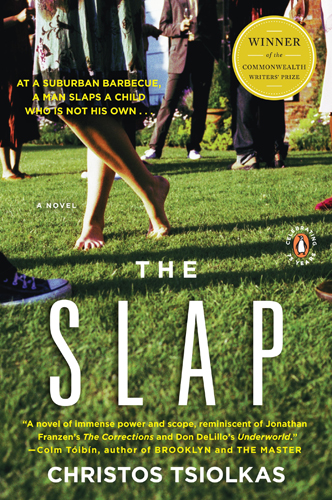
Review: The Slap

The Slap is another paperback I picked up for free at Newtonville Books after buying a full-price hardcover (see July 24, 2012, "Review: That Old Ace In the Hole").

I'd never heard of the book or its author, Christos Tsiolkas, but I liked the premise: a man slaps somebody else's child at a backyard barbecue, and as a result, a group of friends, acquaintances and family members question their parenting abilities, their cultural differences, their ideals and their relationships to each other.

Plus, it's an Australian tale and who doesn't love the Aussies?

As with the last book I read, Annie Proulx's "That Old Ace In the Hole," I feel that this book could've used a heavier edit. What's wrong with a novel that's under, say, 400 pages?

As someone who self-published a book ((C)rock Stories: Million-Dollar Tales of Music, Mayhem and Immaturity) that needed better editorial oversight, I know of what I speak. I had spent so much time getting the book ready for publication (10 years, give or take) that I couldn't stomach the idea of someone telling me where to make changes, or questioning the ideas in my book.

But if you're working with an actual editor and publisher, your book should be tighter than Tsiolkas's book. Still, I enjoyed his story and his method for presenting the multitude of difficult and intricately woven issues.

There are eight chapters, each one told from the perspective of a different character. I was impressed at Tsiolkas's ability to see life from so many different angles, both male and female, young (18) and old (69), and make each one seem true to life.

I thought he did an especially good job with the internal monologues of each of the characters. As someone who does a lot of self-talking (what probably appears to the outside world as crazy talk), I can relate to the world of inner thoughts, and how different that realm is to the persona we put forward.

And the view into the various cultures of Australia -- many of the characters are Greek immigrants and their children and grandchildren -- was fascinating. How do the Greeks deal with each other, and the aboriginal natives, and those of English descent? And what are the conflicts among friends who are Christian, Muslim, Hindu or atheist? Good stuff all around.

I know this isn't the most thorough review, but I started this a while back and just want to finish it up, so in conclusion I'll just say that I recommend the book.

G'day!

Thursday, August 2, 2012

Hidden History

I'm a history buff, but not the kind who reads tomes about World War I, watches Hitler documentaries on the History Channel or re-enacts the Civil War.

I've researched my family's genealogy, and I enjoy learning about long-forgotten automobile brands, or looking at photos of vanished motels on Route 66. I maintain another blog, The Backside of America, where I post photos and write a little bit about faded parts of this country, from abandoned railroad tracks to moldering factory buildings, rusty cars left to die in the woods to old ski hills that have become magnets for taggers. The blog has several loyal contributors, thankfully.

I've spent quite a bit of time in the last few years tromping around urban, suburban and rural landscapes trying to uncover bits and pieces of the past.

Earlier this week, while doing some research online for a series of children's books, I stumbled across a piece of hidden history that fascinates me with its glimpse into the not-so-distant past and confuses me as to why it still exists.

The Walden Street Cattle Pass in Cambridge was built in 1857 in order to move cows from the railroad (now the Fitchburg line of the commuter rail) to nearby stockyards. Although those yards were closed around 1870, cattle continued to be unloaded from what eventually came to be known as Porter Square, herded down Massachusetts Avenue through Harvard Square, and to the slaughterhouses across the Charles River in Brighton (This information is available at a number of web sites, most of which seem to have gotten it from a plaque on the Walden Street Bridge, which I checked out yesterday).

(This isn't my picture, obviously. It came from Wikipedia.)

I loved discovering some of the history of Porter Square, an area I've hung out in and driven through countless times in my 20+ years in the Boston area. The square was named for Zachariah Porter, who ran a popular hotel and restaurant in the area. The porterhouse steak was named in his honor as well.

And the idea of cattle being herded down Mass. Ave and on through Harvard Square is quite the visual. Nowadays, the stretch between Porter and Harvard squares is jammed with funky shops, cool restaurants, hair salons, music stores, etc. And of course, Harvard Square is "where the weirdos" hang out, as any conservative worth his or her salt will tell you.

The cattle pass was added to the National Historic Register in 1994, and restored in 2007-8 when the Walden Street bridge was torn down and replaced. Here's the thing, though: you can't actually see the cattle pass unless you ride the commuter train, because the new bridge covers it completely.

Yes, this fascinating piece of history is hidden away under the bridge. I tried to see it when I stopped by yesterday, but it's impossible. According to one online source, the Cambridge City Council has discussed creating a vantage point for viewing the tunnel.

While I applaud the state for restoring the cattle pass, I wonder about spending money on a place that almost nobody can appreciate in person. I don't really see the city council spending money to construct a scenic overlook for this landmark.

This discovery set me to wondering about other historical remnants that exist out of our view. This curiosity is what gave birth to the urban exploration movement, and what leads me to Google Maps, looking for places to take pictures and shed a little light on the past.