Showing posts with label novel. Show all posts

Saturday, February 6, 2021

Book Review: Radio Waves: A Post-Punk Novel

I first met Shawna-Lee Perrin in late 2010 at a release party for my short-story collection, (C)rock Stories: Million-Dollar Tales of Music, Mayhem and Immaturity. She and her husband, Dave, traveled south from the Granite State to Waltham, Mass., to hear me read from my first book in the back room of the Skellig Pub (R.I.P.). We'd been Facebook friends for a few years, as we had friends in common from our respective days at Keene State College.

Back then, I wouldn't have guessed that 10 years later I'd be in a band with Shawna, and that I'd be extolling the virtues of her first book, Radio Waves: A Post-Punk Novel.

For years, our friendship remained a Facebook construct, maintained largely through commenting on each other's photos, rants and YouTube clips. I learned that we had a lot of similar musical tastes (old-time country music, some punk rock and post-punk). At some point, Shawna posted about studying creative writing through the Mountainview MFA program. As she traveled along the path to writing her first novel, we communicated here and there about her progress. I was excited for her, as I am for any friend or family member who makes the leap from "Some day I'll write a novel/record an album/fill that canvas" to "I'm actually doing it!"

While she plugged along on her novel, I was working on the road-trip memoir that I've written about here over the years. We would occasionally check in with each other to see "How's it going?" Writing is a lonely craft, so community outreach is important.

Shawna and my college chum Ken also knew each other through various channels, and at some point discussed playing music together. Since our time playing in The Toastmen at Keene State in the mid-'80s, Ken had played with at least a handful of bands in Rhode Island and New Hampshire, honing his lead-guitar chops. I don't think Ken and Shawna ever jammed.

Fast-forward to the fall of 2019. Ken and I put the word out on Facebook that we were looking for musicians to join our newly formed combo, The Slade Wiggins Band. Shawna said she and her husband, Dave, were interested. They'd played in a few bands together over the years, she on bass and him playing banjo, guitar and fiddle. For our little combo, Dave offered to play drums, something he'd picked up in recent months. Ken and I were happier than a double-neck guitar is to be strapped around Jimmy Page's shoulders.

We jammed in November of that year, and the four of us clicked pretty well, musically and socially, as Dave and Shawna are two of the nicest, most easygoing folks you'll ever meet. In between working on a few originals and a few covers (Hank Thompson, Silver Jews), Shawna and I talked about our respective books, and offered to help each other any way we could.

Before too long, Shawna put it out on Facebook that she was looking for folks to read the latest draft of what would become Radio Waves, and I happily agreed to dig in. Her story grabbed me right from the start, as it is about music that I love and people who I can relate to. I offered some constructive criticism, which she happily accepted. I also sent a draft of my road-trip memoir to her, and she provided lots of great notes on it.

Now, Radio Waves is out! I'm so excited for Shawna, because I know how hard she's worked to write her novel, and to get it published. And the book is great, even better than the draft I read a while back. Shawna has infused her lead character, Viv, with amazing passion for music. She lives for post-punk, punk and New Wave bands, from Wire and The Clash to Blondie and The Ramones. But it's Joy Division that unlocks her soul.

Let me say this: you don't need to be a total music spazz like I am to relate to Viv's story. Radio Waves is a coming-of-age story, a love story, an adventure tale, a music history lesson and so much more. Set in 1979-80 in New Hampshire and London, the novel finds Viv in her senior year in college, working at the school's radio station and contemplating whether she's ready to get married, settle down and have kids. Her fiance, Adrian, seems to have their life together planned out, even though he doesn't really know what makes Viv tick; he calls her musical tastes "weird" and "upsetting."

Viv practically lives at the radio station. She has developed her strongest friendships there and risen up the ladder from a 17-year-old trainee to co-music director. She goes inside those graffiti- and sticker-covered walls when she needs to get away from the world when it all seems to much: Adrian pressing her on their forthcoming nuptials and transition to an "adult" life; her mother bombarding her with questions about wedding minutae.

In the midst of her young-adult crisis, she meets John, who is visiting his brother Noel, a freshman at Viv's college. The brothers are from England; John and Viv make an instant connection over music and quite quickly they fall into each other's arms.

I'm not going to write anything more about this book, because I want you to go and buy it and read it. You can get it here.

Here's a little taste of Joy Division, for those of you who aren't familiar with this influential British band, which lasted for just a few years in the late '70s and early '80s.

Friday, November 9, 2012

NaNoWriMo Revisited

Five years ago I took part in National Novel Writing Month. Known as NaNoWriMo, the endeavor challenges folks to write a 50,000-word novel between 12:01 a.m. on November 1st and 11:59 p.m. on November 30th each year.

Encouraged by my buddy Jay, I decided to devote as much time as possible to this adventure. I did so knowing I wouldn't get enough sleep, as my daughter was just four months old and was waking up regularly during the night for feedings. Regardless, I wrote until midnight on many of those November nights.

Because I was constantly tired, naturally I became grouchy during the days and evenings, which, believe me, didn't go unnoticed by my wife.

Still, I managed to crank out roughly 26,000 words over those 30 days. I'd made an outline of my proposed novel ahead of time in order to make the process go more smoothly. I decided to turn the UFO/alien abduction concept album I'd been working on into a book, with the grand idea that at some point I'd release both works of art as an incredible multimedia extravaganza.

I was proud of myself for being so resourceful and for preparing in advance. In years past I'd tried two or three times to write novels, but after wading in quite a distance, I found myself over my head with no idea how to swim back to shore. So those novels died.

And so did my NaNoWriMo effort after that 30-day burst of activity. Sure, I looked at it a number of times in the ensuing months, and tweaked it a bit here and there. But even working from an outline didn't make the process much easier.

Because the object of NaNoWriMo is to crank through and produce as many words as you can and worry about what it all says later, I ended up going off on all sorts of tangents, and not sticking to my outline.

I forgot about the novel (well, not entirely; it's always in the back of my head) and spent time working on my short story collection. I self-published that in December 2010 (buy it here -- the holidays are coming!). After that, I kicked around some children's book ideas. I've developed a concept that I like, and am working with an illustrator, so with any luck I'll crack that market in the near future.

Also, in April of this year I started working on a memoir. I've made great progress on this book, and am nearly ready to send it out to some folks to gather opinions and critical feedback.

So it sounds like my literary plate is full, right? But last weekend at a PTO function I met a woman who's a published novelist, and she mentioned the idea of forming a writer's group with a few other people she'd met that night. One of these guys is somebody with whom I've already spent considerable time discussing our respective books.

These other writers are working on novels, but I think they'd be OK with discussing my memoir in a group. Still, I thought I'd like to at some point be able to bring fiction into the mix.

I thought about starting a new short story collection, but found that prospect too daunting. Then I did what I knew I had to do: I committed myself to returning to my novel, despite the fact that on this very blog I recently announced that my brain just doesn't work the way a novelist's brain should work (see October 2, 2012, "The Struggle.").

I returned to the manuscript this week and started making notes about what needs to change, what needs to get thrown out, who the characters are and how I'm going to move the story forward and not give up like I have in the past.

I may ditch the story again. I may take 10 years to finish, just as I did with my short story collection. But I'm determined, one way or the other, to write a novel.

I'll keep you updated, but don't hold your breath.

Thursday, August 16, 2012

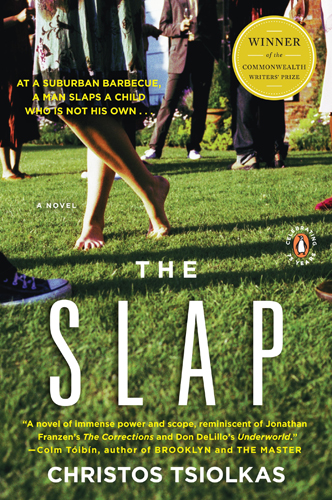
Review: The Slap

The Slap is another paperback I picked up for free at Newtonville Books after buying a full-price hardcover (see July 24, 2012, "Review: That Old Ace In the Hole").

I'd never heard of the book or its author, Christos Tsiolkas, but I liked the premise: a man slaps somebody else's child at a backyard barbecue, and as a result, a group of friends, acquaintances and family members question their parenting abilities, their cultural differences, their ideals and their relationships to each other.

Plus, it's an Australian tale and who doesn't love the Aussies?

As with the last book I read, Annie Proulx's "That Old Ace In the Hole," I feel that this book could've used a heavier edit. What's wrong with a novel that's under, say, 400 pages?

As someone who self-published a book ((C)rock Stories: Million-Dollar Tales of Music, Mayhem and Immaturity) that needed better editorial oversight, I know of what I speak. I had spent so much time getting the book ready for publication (10 years, give or take) that I couldn't stomach the idea of someone telling me where to make changes, or questioning the ideas in my book.

But if you're working with an actual editor and publisher, your book should be tighter than Tsiolkas's book. Still, I enjoyed his story and his method for presenting the multitude of difficult and intricately woven issues.

There are eight chapters, each one told from the perspective of a different character. I was impressed at Tsiolkas's ability to see life from so many different angles, both male and female, young (18) and old (69), and make each one seem true to life.

I thought he did an especially good job with the internal monologues of each of the characters. As someone who does a lot of self-talking (what probably appears to the outside world as crazy talk), I can relate to the world of inner thoughts, and how different that realm is to the persona we put forward.

And the view into the various cultures of Australia -- many of the characters are Greek immigrants and their children and grandchildren -- was fascinating. How do the Greeks deal with each other, and the aboriginal natives, and those of English descent? And what are the conflicts among friends who are Christian, Muslim, Hindu or atheist? Good stuff all around.

I know this isn't the most thorough review, but I started this a while back and just want to finish it up, so in conclusion I'll just say that I recommend the book.

G'day!

Tuesday, July 24, 2012

Review: That Old Ace in the Hole

Newtonville Books is a great local store. When they were actually located in my adopted 'hood of Newtonville -- before their move to the tonier Newton Centre -- they for a time offered buyers of hardcover books a great deal: a coupon for a FREE used paperback.

I picked up a bunch of freebies through that offer, a few of which I've read. This week I finished Annie Proulx's That Old Ace in the Hole.

Proulx is well-known and highly regarded. She won the Pulitzer Prize for The Shipping News, which I thoroughly enjoyed, and garnered recognition for her 1997 short story, "Brokeback Mountain," which Ang Lee turned into an award-winning film in 2005.

So after pawing through lots of books by authors I'd never heard of, I was excited to find Proulx's 2002 novel about a young man sent by his new employer to the Texas Panhandle to scout locations for hog farms.

I have to say, though, that the book left me somewhat unfulfilled, as though I'd ordered the Lumberjack Special at my local diner, and instead of Canadian bacon on the side they gave me veggie bacon strips (side note: why hasn't anybody copyrighted Facon and turned it into a viable commercial product?).

Proulx fills the book with incredible descriptions of the Texas landscape:

And it was crazy country too, some of the flattest terrain on earth, tractor-chewed and rectangled, rugged breaks and plunging canyons, sinister clouds too big to see in one look, rusty rivers, bone white roads and red grass -- the oddly named bluestem."

And she populates the book with loads of colorful characters with even more colorful names, such as Freda Beautyrooms, Rope Butt and Ribeye Cluke. As a guy who discovered a love for writing in second or third grade by making up stories featuring the most ridiculous names I could think of, I chuckled at each of Proulx's way-out character names. But eventually I found them a distracting device.

The protagonist, Bob Dollar, has an appropriately generic name, as he really doesn't displace much water in the story, but seems only to serve as a sounding board for other people's opinions and ideas.

He never cares about his job at Global Pork Rind, understandably. But he feels a sense of loyalty, which he attributes to his not wanting to abandon his responsibility the way his parents left him behind as a child, with an uncle, when they took off for Alaska. The corollary just doesn't work.

I was sorely disappointed that this book just didn't seem to ever really come together. I felt as though Proulx kept stringing things along -- plots, character development, scene descriptions -- because she didn't really know how she wanted to end it.

And when the ending did come, it was with a whimper, not a bang, which I guess is appropriate given how dull a character Bob Dollar is.

Now, I'm not gonna lie to you and tell you that I didn't enjoy this book at all. I wouldn't have plowed through its 359 pages otherwise. But I wanted the book to be great, not just OK. I wanted there to be a big surprise or shock here and there, but there really wasn't.

I guess that's why I found this book in the used section, and got it for free.